In a smart, bright office in the heart of central London, the glamorous fertility doctor makes her pitch. Sitting in front of her is a 30-year-old woman, who says she definitely wants children, but not for another decade.
‘Then it’s a good idea to freeze the eggs,’ says a smiling Dr Vidya Atluri enthusiastically. ‘It is a very good idea to freeze the eggs.’
This private clinic – the Centre for Reproductive and Genetic Health (CRGH), which charges £3,000 for egg freezing – claims to offer the best success rate for the process in the country. Women who visit its website are bombarded with beautiful images of babies and children.
One shows a slim, ponytailed young mother holding an adorable infant in her arms as the sun sets behind her. In another, a smiling woman reaches out to embrace a gorgeous, fair-haired toddler.
Emblazoned over a third – a close-up of a sleeping baby, his fist tucked under his chin – is the boast: ‘Highest number of live births using frozen eggs in the UK.’ There has been a remarkable rise in the number of British women freezing their eggs, with 315 women having the treatment in 2010, compared with 816 in 2014.
Most of these are said to be doing so for ‘social’ reasons – they know they want a baby and are anxious to ensure it will be possible in the future, but they haven’t yet found the right partner, or are worried about abandoning their career.
Some firms even offer the treatment as a perk. Apple and Facebook subsidise egg freezing for female employees, up to a cost of around £16,000. But the technique can also be used by cancer patients, offering a chance of saving healthy eggs before chemotherapy or radiotherapy leaves patients infertile. For all these women, the clinic’s promise of an unbeaten success rate for egg freezing combined with pictures of happy mothers and beautiful babies inevitably pack a powerful emotional punch. The clinic even offers free consultations for those considering egg freezing. They last around 15 minutes – perfect for a busy career woman on her lunch break.
But can women really be confident that paying thousands of pounds to freeze their eggs will give them a decent chance of having a child when they reach their forties – or even beyond? In Dr Alturi’s office, this is precisely what the 30-year-old woman who has come for a free consultation wants to know. If she freezes her eggs now, what exactly are the chances of her being able to use them to have a baby at 40?
‘It’s very good,’ Dr Alturi says. ‘CRGH is highest in the country – 65 per cent is our success rate.’ The woman presses her, and Dr Alturi is emphatic. ‘65 per cent,’ she says. ‘It is good. Because the eggs are frozen when you are 30.’
On this occasion, the patient will not be going ahead. She is, in fact, an undercover Mail reporter investigating concerns that this clinic and others are making misleading claims about the success rate of egg freezing and exploiting young, single women desperate to ensure they can have a baby one day.
In reality, the claim that our reporter would have a 65 per cent chance of success with a frozen egg is wildly exaggerated.
The most recent official figures from the Human Fertility and Embryology Authority watchdog show that each frozen egg thawed for use has about a 2 per cent chance of resulting in a live baby.
Of course, treatment cycles include several eggs – usually eight or nine – which are defrosted in the hope they will survive, be fertilised and then implanted successfully.
 But statistics show that for every cycle of treatment using frozen eggs, there is only about a 15 per cent chance of having a baby.
 After the Mail’s undercover reporter left CRGH’s offices – past couples waiting anxiously for treatment – the Mail asked the clinic for proof of its remarkable 65 per cent success rate.
A spokesman said that in one year – 2014 – it had ‘a pregnancy rate of 64.3 per cent’. Crucially, however, this was the rate of pregnancy ‘per embryo transfer’.
This emphatically does not mean that women aged 30 will have a 65 per cent chance of ending up with a baby from a frozen egg.
That’s because before this ‘transfer’ stage, frozen eggs must first be successfully thawed, fertilised, and grown into healthy embryos. During this complex process, about five in six frozen eggs are lost, HFEA figures show.
Even if a woman is lucky enough to become pregnant with a frozen egg that is successfully thawed, fertilised, grown into an embryo and transferred, a significant proportion of those pregnancies will end in miscarriage.
Therefore, the ‘success rate’ of 65 per cent quoted to our reporter and featured on the website – refers to just one specific part of a complex and risky process in one year.
In other words, it’s highly selective – and downright misleading.
Another major egg-freezing centre is the Lister Fertility Clinic in London, where three rounds of egg freezing cost more than £10,000. Holding court at a recent open evening was gynaecologist Dr James Nicopoullos, a handsome man with salt-and-pepper hair, wearing blue medical overalls.
His captivated audience were half a dozen women, all single and some recently heartbroken.
One – an attractive brunette in her early forties – tells the group that the man she thought she would have children with had left her for a younger woman. Clearly vulnerable, she said she wanted to freeze her eggs as soon as possible. The emotion in her voice was palpable. During a projector presentation, the charming consultant offers a balanced perspective, accurately quoting HFEA figures.
But he then claims the watchdog’s data is flawed. It does not differentiate, he says, between women’s ages or old-fashioned slow-freezing techniques and the faster, more successful technique used by his centre. He claims this means his success rate is much better, with frozen eggs at his clinic ‘behaving like fresh eggs’.
As a result, he suggests patients have a 40 per cent chance of having a baby by freezing their eggs if they do so in their mid-thirties, and 38-year-olds have a 30-per-cent chance. The women should aim to get ‘15 or 20’ eggs to have ‘a reasonable insurance policy,’ he says.
He says that although egg freezing doesn’t ‘guarantee’ pregnancy, ‘it’s an option that I think is a successful one.’
As the women scribble notes furiously, he adds: ‘The key is, is freezing your eggs going to give you an alternative that could be better to where you are in the future? That’s what you guys, that’s what you need to decide.’
When we later asked the clinic to justify these claims, it said the figures given to the women were not for frozen eggs, but for fresh egg cycles. A spokesman said that Dr Nicopoullos explained to the audience that the figures related to fresh eggs. They were included, however, on the premise that frozen eggs at the Lister act like fresh eggs. So what is its real success rate with frozen eggs?
The spokesman said that out of ‘31 women who have returned to use their [frozen] eggs, ten achieved a pregnancy, of which nine have either delivered or are well into pregnancies’ – adding: ‘These are very positive results.’
This shows the Lister Fertility Clinic – based on a very small set of data – has a live birth rate of about 29 per cent from frozen eggs. Impressive compared with national statistics, but nothing like the figures quoted by Dr Nicopoullos.
The clinic said his claim that women had a 40 per cent chance of having a baby was based on internal statistics showing a 40 per cent live birth rate per embryo transfer.
A spokesman said one in 27 eggs thawed by the clinic led to a baby, adding: ‘We are committed to ensuring people are given transparent information and responsible medical advice to help them make informed decisions.’
A spokesman for CRGH said Dr Atluri quoted the most relevant statistics relating to in-house success rates. It said that because a live birth rate of 5-7 per cent per frozen egg has been documented, and around ten eggs are used, ‘a success rate of 50-70 per cent could potentially be achieved’.
It said free consultations only offered summaries of treatment options. Genuine patients would have further tests and consultations in which statistics would be explained fully. A spokesman said it did not promote delaying motherhood, adding: ‘We would never try and sell a procedure. We would only offer a treatment when we deemed it suitable for the patient.
‘Egg freezing is offered as an option to give a patient a chance of preserving her fertility if that patient deems it is not possible for her to have a child at that time. We cannot guarantee a child.’
Source: Dailymail
ABUJA: Training Schedule for Basic Life Support BLS, Pediatric Advanced Life Support (PALS), Advanced Cardiovascular Life Support ACLS, First Aid, CPR, AED
PORTHARCOURT: Training Schedule for Basic Life Support BLS, Pediatric Advanced Life Support (PALS), Advanced Cardiovascular Life Support ACLS, First Aid, CPR, AED
LAGOS: Training Schedule for Basic Life Support BLS, Pediatric Advanced Life Support (PALS), Advanced Cardiovascular Life Support ACLS, First Aid, CPR, AED
STOP paying for airtime and electricity, Let your phone pay its bills with ScreenT
You may also like

FG Supports Robotic Surgery Expansion to Reduce Medical Tourism
Nigeria is taking another step toward strengthening specialised healthcare …
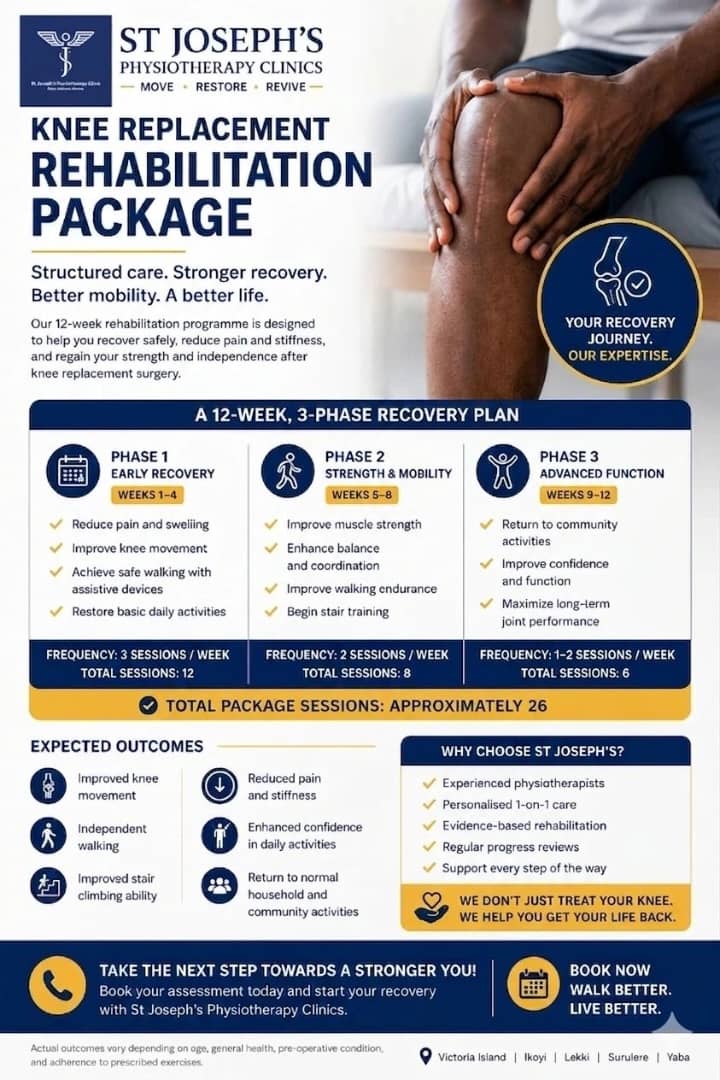
Complete Knee Replacement Rehabilitation Package in Lagos
Knee replacement surgery is a major step toward pain relief and improved mo…

NAMDA threatens strike over unpaid medical lecturers’ allowances
The Nigerian Association of Medical and Dental Academics (NAMDA) has warned…

Resident Doctors Signal End to Strike Threat After High-Level Talks with Gbajabiamila
The threat of a nationwide indefinite strike by the Nigerian Association of…
AMLSN Issues Strong Rejoinder to NAMDA on Public Service Establishment Matters
The Association of Medical Laboratory Scientists of Nigeria (AMLSN) has rel…