The presence of rampant corruption in our country is no longer news. What is important is for us as a people and as individuals is to analyse how it affects us in different ways. Today, we shall look at how it undermines efforts to improve healthcare delivery, increase life expectancy and build upon the successes recorded in childhood immunisation efforts in the country.
In as much as healthcare provision is a social service, so is politics when they are played in accordance with the norms and the provision of good health to the majority of the citizens is seen as a goal. In a recent session of argument with a friend, his position was that the fight against corruption must be seen as an emergency social security priority and none more so than in the health sector.
His reasons for assuming that position were an eye-opener. This is because when you have healthy citizens, they are more productive, enterprising and much less likely to engage in activities which might endanger their health or their lives while in active pursuit of their daily bread. They will not indulge in prostitution and certain kinds of criminal activity or use narcotics. Consciousness of the consequences of doing any of these would help to keep them in check. However, when people feel they have had their future stolen by other citizens in authority, it is likely to propel them to acquire riches by whatever means they deem fit even at the risk of gravely compromising their health.
All of that, of course, is conjecture. Many people in authority seem to think more in terms of what the system they head can do for them rather than seek ways to improve the lot of the common folks. As a result, somebody wakes up one day and decides to set up a gigantic diagnostic facility in the middle of nowhere or sometimes even within an existing hospital because the expected kickback from such a project would be in several hundred millions of naira rather than furnish the same hospital with the basic diagnostic tools that are so sorely lacking. As a result, few people will benefit from the first structure because not many can afford to pay for it or because the patients who are expected to benefit from such a facility are indeed only a small fraction of the vast number of sick people who pass through the hospital annually.
Secondly, the greater number of patients who should benefit from the cheaper modes of diagnosis are denied that privilege because the people who should know have not considered it necessary to help provide those tools. As an example, during a visit to the Lewisham University Hospital, Riverside, London, United Kingdom, every consulting room in the departments of obstetrics, gynaecology and surgery had an ultrasound machine available to aid diagnosis and ease the burden of the work. In addition, every desk had a computer that had real-time links with both the laboratory and the radiology departments (not for Facebooking). At a click of several buttons, every detail of the patient is on the screen. And this is not even a top of the range NHS hospital. At home, the entire budget for equipping one large hospital with these facilities will probably be less than N100m. It will positively impact so many people who need them without a doubt. But the expected kickback will be less than N20m. Not attractive enough perhaps.
What we have been witnesses to is a systematic degradation of quality hospital care that is vastly at odds with the 21st Century. We now see hospitals which in the recent past were able to conduct total knee replacement and open heart surgery gradually becoming unable to do so. As the service dies, so does the training of the younger crop of staff who should improve on what their seniors have achieved. Worse, and even more terrifying, is the baffling scenario across the country today where young doctors, pharmacists, physiotherapists, nurses and biochemical engineers graduate from the university and are unable to find placements for internship. People of Nigeria, this is a mandatory requirement of their training that must be conducted before they can attain the license to practice their trade. When they are unable to do so, what does that bode for the further development of manpower in a critical sector?
 Worse, this is a state of affairs that often persists for two or three years now before such positions become available. For those who have been fortunate enough to do their internship, and wish to specialise in various fields, success at the first stage of the professional examination does not guarantee a fixture. This affects the doctors and nurses more than the others and it is an annoying paradox. This is so because all hospitals in Nigeria, without exception are lacking in the required complement of staff and yet are unable to employ the number of professionals they need. There is worse yet. Some people, desperate to specialise, are allowed to engage in post graduate training on the condition that they do not receive any salary. It is known as super-numerary appointment. This is happening in the country of their birth, the country that spent so much to train them to their current level. And yet, there is a budget for all such training. Very often, between the various agencies and the hospitals where the funds are destined to be spent, a significant percentage finds its way into the pockets of powerful people. As a result, the village wallows in poverty and disease, while the chief of the clan enjoys the spoils of his high office. Sometime ago, we heard of aid money going into private pockets and the drugs pledged for HIV/AIDS, tuberculosis and malaria finding their way into private pharmacies. Thus, the true beneficiaries are left with nothing.
 In response to the difficulties encountered by patients who are unable to get both diagnosis and treatment in the same facility, private individuals have stepped in to fill the void. This does no good to either the patient of the hospital requesting such an investigation. Sick persons are made to transport themselves at great discomfort in all kinds of vehicles to have the required investigations done. When the dichotomy between manpower needs is placed alongside the deficit in required equipment, you will understand that as far as our healthcare is concerned, we live in a time of enormous peril.
ABUJA: Training Schedule for Basic Life Support BLS, Pediatric Advanced Life Support (PALS), Advanced Cardiovascular Life Support ACLS, First Aid, CPR, AED
PORTHARCOURT: Training Schedule for Basic Life Support BLS, Pediatric Advanced Life Support (PALS), Advanced Cardiovascular Life Support ACLS, First Aid, CPR, AED
LAGOS: Training Schedule for Basic Life Support BLS, Pediatric Advanced Life Support (PALS), Advanced Cardiovascular Life Support ACLS, First Aid, CPR, AED
STOP paying for airtime and electricity, Let your phone pay its bills with ScreenT
You may also like

FG Supports Robotic Surgery Expansion to Reduce Medical Tourism
Nigeria is taking another step toward strengthening specialised healthcare …
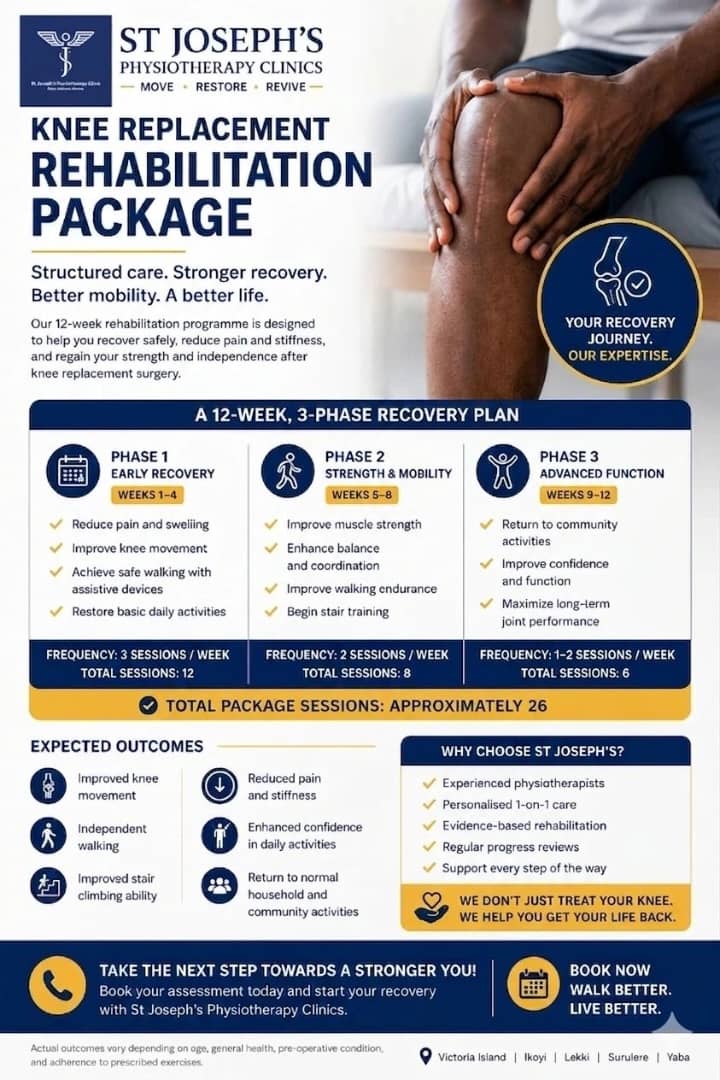
Complete Knee Replacement Rehabilitation Package in Lagos
Knee replacement surgery is a major step toward pain relief and improved mo…
NAMDA threatens strike over unpaid medical lecturers’ allowances
The Nigerian Association of Medical and Dental Academics (NAMDA) has warned…
Resident Doctors Signal End to Strike Threat After High-Level Talks with Gbajabiamila
The threat of a nationwide indefinite strike by the Nigerian Association of…
AMLSN Issues Strong Rejoinder to NAMDA on Public Service Establishment Matters
The Association of Medical Laboratory Scientists of Nigeria (AMLSN) has rel…