Born on June 12, 1959, Prof Aramide Faponle is the President of the Society for the Study of Pain, Nigeria and a Council Member, West African College of Surgeons. Faponle, who is a professor of Anaesthesiology and former Deputy Provost, College of Medicine, Obafemi Awolowo University, Ile-Ife, tells SUCCESS NWOGU about her career and life
Is Nigeria’s medical environment favourable for surgeons?
It is not favourable. A lot of times, the equipment to work with are not available. When you know things you can do and you do not have things to work with, it makes it difficult for you; you don’t enjoy your work. Also many of our patients are poor. You see patients going to hospitals when it is late because they do not have money. Many times, some of my colleagues and I have to dip our hands into our pockets to assist patients to be able to do things they ought to do in the hospital for their surgical needs. We work under very difficult situations.
Have surgeons lived up to expectations with regards to the efficient discharge of their responsibilities in the country?
As much as we can, we are living up to expectations. Even the circumstances in which we work, with the limited facilities we have, the hostile environment that we have, we are doing much more than we can afford to do under the circumstances.
So what could be done to improve service delivery of surgeons in the country as you have mentioned some of your challenges?
Hospitals should be better equipped. We can do a lot. You train in Nigeria and abroad and you are exposed to a lot of things. And then you come back here and find that half of the things that you need are not available. So the government should do much more in terms of equipping our hospitals. The government should provide for hospital managers things that are necessary, at least to provide the barest of services. Then the National Health Insurance Scheme should provide much more than they are providing now so that many more people can come in for their operations under some form of medical insurance. That means we would be seeing more patients and we would not be seeing them at the tail end of their medical problem, so that we can still give some good services to them.
Is it because of dearth of sufficient qualified medical personnel and inadequate equipment many Nigerians are seeking medical treatment abroad?
It is not because of the dearth of sufficient qualified personnel. It is the fact that, for many of us, we do not even know what we have. For instance, in my own hospital, each time people come for accreditation, they are amazed at the kind of services that we are able to offer. But the thing is that so many people are not aware of what is happening in many hospitals, who is where and who is doing what! When we are able to let people know what we are doing, I think we will be able to have less of this medical tourism. And then, some of us like to downgrade what is happening in Nigeria. I believe there is a lot that is good in terms of medical care in Nigeria. Many of the things that we go abroad for and the complications that are there, are still the kind of things that we find in medical practice here.
For instance, we do renal plantation in my hospital, many patients who go to India for their transplant become our patients for post-transplant cases and we can manage them. And we see them, they will say, “Oh I did not know that you people can do it and do it well.” Now that they have run into trouble and they cannot get to India, they now know that what is in the country can be extremely helpful. So we should be able to say what we are doing, we should be able to know what is available in the country. Nigerians should be proud of their own healthcare services. Even for the smallest of things that we can do, there are patients who will say, “Please just write a referral for me to go to” wherever they are going to. We should have confidence in our system. There is a lot that is good in terms of medical practice in Nigeria. We should exploit it more, we should convince our populace to believe in the system and there is a lot that can be believed in our system.
You talked about people not knowing enough the medical services in Nigeria. Does it mean that medical practitioners should be advertising their services? Is this not against medical ethics and regulations?
That is exactly what hampers us. The law does not allow us to advertise and we are not expected to be advertising what we can do. When the tertiary medical institutions are well funded, we will have enough qualified staff, and when you get there, they will tell you which one they can do. Any doctor or specialist will know their limit. We are trained to know our limit and we are trained to know what will be referred to other doctors. We know ourselves, so if I cannot do something where I work, I will know the person who does such thing in another hospital in the country and I can refer you there.
You are a Council Member of the West African College of Surgeons, what are some of the challenges of this association?
The West African College of Surgeons is involved in training specialist surgeons in the country. The college has existed for well over 50 years now and by the virtue of its existence, we have produced manpower for different specialties all over the country. Along with the training, we also do accreditation, that is, we also look into the training of the specialists in our various teaching hospitals and we try to give guidelines as to what is supposed to be available to train the different cadres of specialists. So the challenge over the years is still that we have a lot of our people who are training here now who do not have the kind of exposure that we had in the 1960s and 70s when a place like the University College Hospital, Ibadan was offering services that were equal to what you would get in any of the Commonwealth countries.
ABUJA: Training Schedule for Basic Life Support BLS, Pediatric Advanced Life Support (PALS), Advanced Cardiovascular Life Support ACLS, First Aid, CPR, AED
PORTHARCOURT: Training Schedule for Basic Life Support BLS, Pediatric Advanced Life Support (PALS), Advanced Cardiovascular Life Support ACLS, First Aid, CPR, AED
LAGOS: Training Schedule for Basic Life Support BLS, Pediatric Advanced Life Support (PALS), Advanced Cardiovascular Life Support ACLS, First Aid, CPR, AED
STOP paying for airtime and electricity, Let your phone pay its bills with ScreenT
You may also like

FG Supports Robotic Surgery Expansion to Reduce Medical Tourism
Nigeria is taking another step toward strengthening specialised healthcare …
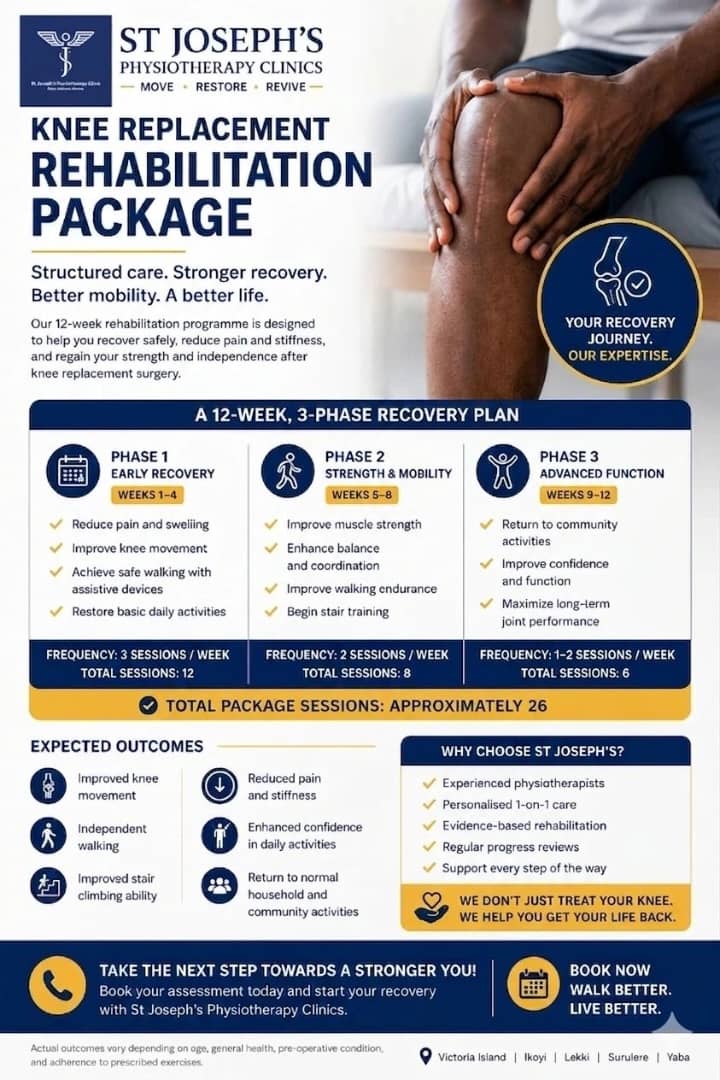
Complete Knee Replacement Rehabilitation Package in Lagos
Knee replacement surgery is a major step toward pain relief and improved mo…

NAMDA threatens strike over unpaid medical lecturers’ allowances
The Nigerian Association of Medical and Dental Academics (NAMDA) has warned…

Resident Doctors Signal End to Strike Threat After High-Level Talks with Gbajabiamila
The threat of a nationwide indefinite strike by the Nigerian Association of…
AMLSN Issues Strong Rejoinder to NAMDA on Public Service Establishment Matters
The Association of Medical Laboratory Scientists of Nigeria (AMLSN) has rel…