President of the Blood Pressure Control Foundation, Dr. Jacob Nwachukwu, has cautioned Nigerians (black people) against usage of hyperten-sion drugs made for con-sumption of the white race.
According to him, users of such drugs usually think they are superior to the local ones because of their white origin.
Speaking at a training programme organized by Omron Academy in collabo-ration with Association of Community Pharmacists, (ACPN) Lagos Chapter, he said, those drugs could be effective for treatment of the disease among the white peo-ple but less efficacious with blacks.
Black people he explained are more vulnerable to the disease than their white counterparts because of the level of salt retention between the two races, hence drugs produced there has higher likelihood not to meet expectation here.
Nwachukwu noted that a peculiarity of blacks with hypertension is the fact their system retains salt unlike the whites where it is eliminated from their system after about 24 hours of consumption and that is why medication for both races are slightly dif-ferent in formulation.
 "That is the way nature made it, hence salt is a more potent risk factor for hyper-tension among people of the black race," he added.
 He however urged hyperten-sion patients who are in this act to rather buy from locally circulated drugs because they have been certified through clinical trials.
Each environment he explained conducts clinical trials on any drug before they are used or openly sold on the market, "in Nigeria, new drugs go through clinical tri-als to test their efficacy in the environment, as well as ensure it suits the needs of Nigerians."
"Hypertension is a lifelong management and it has to be done continuously right, patients are therefore advised against medications based on anecdotal evidence," he expressed.
On the disease's prevalence rate in Nigeria, Nwachukwu responded saying although with the previous blood pres-sure cut off point of 160/95, prevalence was at 21 per cent with reference to the last study conducted in 1983 when Prof. Olikoye Ransom-Kuti was the health minister.
He further told The Guardian that "with the mod-ified cut of points, of 140/90, prevalence rate would be well over 30 per cent if a new study is conducted, because the devastating effects have become enormous."
By: Tayo Oredola
The Guardian News
ABUJA: Training Schedule for Basic Life Support BLS, Pediatric Advanced Life Support (PALS), Advanced Cardiovascular Life Support ACLS, First Aid, CPR, AED
PORTHARCOURT: Training Schedule for Basic Life Support BLS, Pediatric Advanced Life Support (PALS), Advanced Cardiovascular Life Support ACLS, First Aid, CPR, AED
LAGOS: Training Schedule for Basic Life Support BLS, Pediatric Advanced Life Support (PALS), Advanced Cardiovascular Life Support ACLS, First Aid, CPR, AED
STOP paying for airtime and electricity, Let your phone pay its bills with ScreenT
You may also like
Comrade Lemii Christian Emerges Chairman of NANNM Rivers State Branch in Historic Victory
PORT HARCOURT, NIGERIA Following the long awaited National Association of N…

FG Supports Robotic Surgery Expansion to Reduce Medical Tourism
Nigeria is taking another step toward strengthening specialised healthcare …
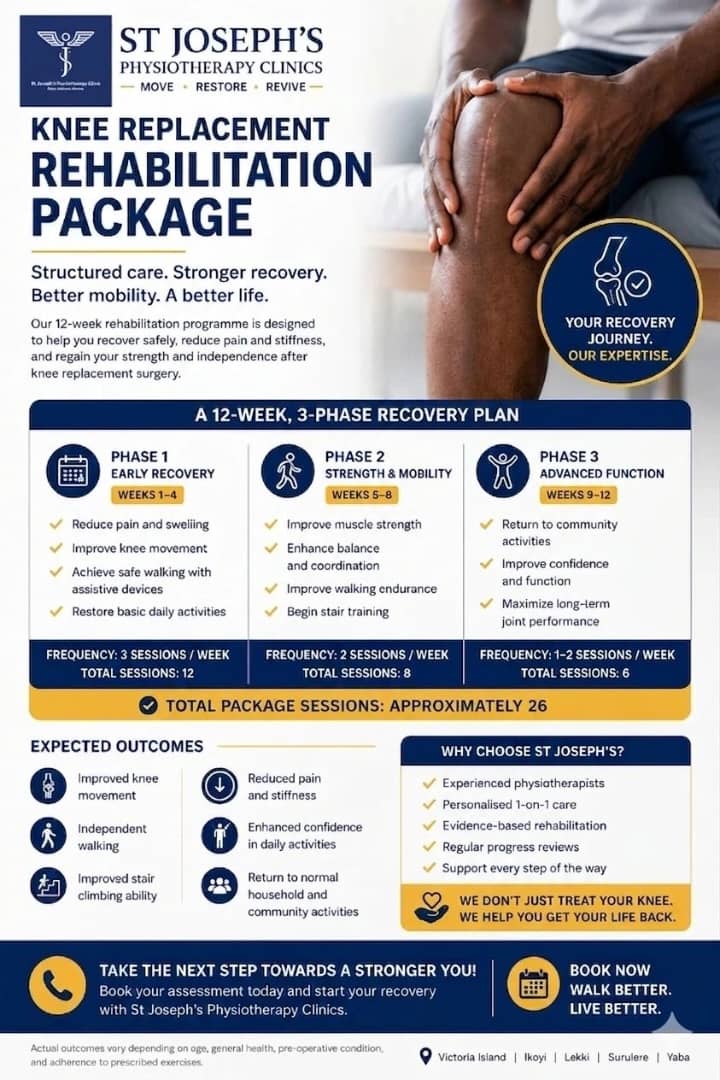
Complete Knee Replacement Rehabilitation Package in Lagos
Knee replacement surgery is a major step toward pain relief and improved mo…

NAMDA threatens strike over unpaid medical lecturers’ allowances
The Nigerian Association of Medical and Dental Academics (NAMDA) has warned…

Resident Doctors Signal End to Strike Threat After High-Level Talks with Gbajabiamila
The threat of a nationwide indefinite strike by the Nigerian Association of…
