THE newly-inaugurated Nigeria Academy of Pharmacy (NAP) has been tasked to champion the fight against fake and adulterated drugs and food products, quest for interdisciplinary harmony in the health sector and development of scientifically-validated and globally acceptable herbal drugs for the treatment of malaria, diabetes, Human Immuno-deficiency Virus (HIV) and other chronic diseases.
The call was made Thursday at the official inauguration of NAP by former Head of State, Gen. Yakubu Gowon; President, Nigeria Academy of Pharmacy (NAP) and former Health Minister, Mr. Julius A. Adelusi-Adeluyi; Emeritus Professor, University of Ibadan (UI)/Medical Director, Ibadan Hypertension Clinic and Consultant Nephrologist, Olujimi Oladapo Akinkugbe; and President, Pharmaceutical Society of Nigeria (PSN), Olumide Akintayo.
The experts said the initiative of the Academy is geared towards coming up with a strong and more focused support group, which will galvanise the PSN to achieve its lofty ideals.
According to the eminent Nigerians, the NAP is a unique one because its output will transcend the routine responsibilities of a conventional Academy and has been structured along operational modalities embracing eight faculties namely: Education, Networking, Governance, Relationship, Strategy, Finance, Membership and Mentoring.
The experts said NAP is not made up of only pharmacists but an array of those who offer a benefit package to Pharmacy and larger society.
Forty-eight distinguished pharmacists, including the late former Minister of Information and Communication and Director-General of the National Agency for Food and Drug Administration and Control (NAFDAC), Prof. Dora Akunyili, were inducted as Foundation Fellows of the Academy.
Gowon, who was the Chairman of the occasion, was also decorated as the Honorary Fellow of NAP.
He began on a memory lane by clarifying issues on the true meaning of his name, Gowon. He said Gowon has been associated with Go On With One Nigeria (GOWON) but it truly means, ‘owner of gods - someone who is in charge with anything to do with gods.’
Gowon urged Nigerians to support him in efforts to keep the country as one. “I need the support of every Nigerian. I thank you for helping me to keep Nigeria as one and even greater,” he said.
On the Nigeria-Biafra Civil War, Gowon said: “It was wrong for us to do to one another what we did but it was a family quarrel.”
On the insurgency and bomb blasts, he said: “I am so sad to see what is happening to Nigeria now. It makes my heart bleeds. Let us not lose hope but forge ahead.”
He led the gathering to observe a minute silence in honour of the late Dora Akunyili even as he charged the Academy on the need to wage war against fake drugs as had been done in NAFDAC with the able leadership of Akunyili.
Gowon said “the country would have been ahead of the Asian Tigers and Brazil if we had run the development plan I started… Unfortunately, that plan was jettisoned. It could have been different.”
He, therefore, urged the Academy and the newly-inducted Fellows not to relent in their efforts in joining hands with other organisations towards production of world class drugs in Nigeria such as vaccines and anti-retroviral drugs (ARVs) which must not only be efficacious but at low price so that they can be available for treatment of common ailments in our society.”
Akinkugbe, who was the guest speaker, in his keynote address titled “Economic Blue Print Towards Health System Transformation” called for interdisciplinary collaboration in the health sciences.
Akinkugbe said the disconnection between the herbalists and orthodox doctors is the main problem in medicine today. He paid tribute to China for recognising the importance of synergy of various disciplines, which led to the development of Artemisinin for the treatment of malaria.
Akinkugbe said the Academy is bound to be a welcome link between apothecary and the scientific basis of medicine, especially herbal medicine.
He said: “Thanks to the World Health Organisation (WHO) recognition of herbal specialists and alternative medicine practitioners, it will now be possible for orthodox medical practitioners to discard their long-standing intellectual arrogance and partner with their other professional colleagues in the further development of medications by proven merit.
“As I speak, there is a small group of Nigerians put together in Abeokuta, looking into the potential of medicinal properties of certain herbs in the treatment of diabetes. The beauty of that small group, which for my sins I happen to chair, is that it is made up of clinicians, diabetologists, biologists, biochemists and senior scientists from Faculties of Pharmacy in existing universities and top researchers from the Nigerian Institute of Pharmaceutical Research.
“We have a generous area of land promised for planting herbs and foliage, experimental animal facilities and laboratories for conducting appropriate research leading to the characterisation of these variegated leafy preparations.
“An Academy such as yours should take more than marginal interest in encouraging such a development. This well-selected motley group will hopefully fulfill society’s highest expectations in bringing gown nearer to town and getting all scientific hands on deck to tie many unresolved loose ends in our nation’s medical armamentarium.”
Akinkugbe said Nigerian scientists have gone beyond the stage of inspired guesswork. He said Pharmacy must expand its coast beyond the ivory tower and “the buy and sell” mentality to be more involved in original work. “I am convinced that herein lies the first challenge of Nigeria’s Academy of Pharmacy,” Akinkugbe said.
He added: “I look forward to the day when in my ward round, clinicians, young and old, the pharmaceutical gurus, the herbalists and traditional medicine men would congregate around the bedside, each espousing his or her art, replacing inspired guesswork and incantations with evidence-based approach to rational therapy, and from which we will all depart with the sense of fulfillment that comes from making worthy contributions to advancing the frontiers of knowledge and improving the health status of our people.”
Adelusi-Adeluyi who is also the Chief Executive Officer (CEO) of Juli Pharmacy, Ikeja, in his address said: “Pharmacy is fortunate to have an abundance of bright minds whose education and experience should be jointly and severally shared while they are still physically with us. The Academy will, inter-alia, provide expert opinion and thought leadership in the education and practice of pharmacy.
“The Academy will provide a platform to influence national and state policies which will enable the fulfilment of the vision, mission, rights and obligations of pharmacy. The Academy will network with similar academies within and outside Nigeria. It will also partner with relevant regulatory bodies and associations to ensure high ethical standards in the practice of the profession and in the war against fake, adulterated and sub-standard products in the health sector.
“The Academy will champion the cause of inter-disciplinarity by working steadfastly to promote harmony and team-spirit among all members of the health team and other relevant professions so that every patient enjoys wholesome and beneficial health care. The Academy will champion the cause of transformational change and innovation through encouraging industry, research and development and seizing the several technology advancement opportunities open to Pharmacare.
“The Academy will, most importantly, concentrate on mentoring the younger generation to confidently build on the foundation being laid today and to facilitate sustainability in areas of capacity and character-building, self-confidence, solid professional reputation and efficient delivery of pharmaceutical service. It is a new day for pharmacy, a new day for the health sector and indeed a new day for our nation, Nigeria.”
Akintayo said as experts in medicines, pharmacists have always been known as an accessible and trusted source of advice and treatment. He said the contributions of pharmacists to healthcare is developing in new ways to support patients in their use of medicines and as part of the clinical decision-making across the range of ailments.
“Professions exist to serve the society, therefore our mission as pharmacists is to address the needs of the society, our duty is to work and ensure that the added value we bring to healthcare and our potentials are taken into account and respected by policy-makers and other health professionals,” Akintayo said.
The PSN president noted that there is a lot of competition, confrontation and distrust in the health sector but the situation must give way for collaboration, consultation and co-operation in the interest of the health consuming public.
He explained: “We must open our hearts and minds to allow the team concept to rule our worlds in healthcare delivery. There is no doubt that the cost of fighting against disease and preserving health will continue to increase in spite of constant control and intervention.
“There are manifold reasons and benefits for wishing to create a genuine co-operation between pharmacists and other healthcare providers. Pharmacists will therefore provide leadership to ensure unity among all the stakeholders in healthcare delivery.”
Akintayo assured his colleagues that pharmacy would take its pride of place in the annals of a great nation that will ultimately evolve.
He said: “ In community pharmacy practice, we shall encourage practitioners to begin to exploit opportunities in maternal and child mortality, which continues to ravage our population, while we stabilise hospital practice by ensuring hospital pharmacists reach the apogee as stipulated in the scheme of service for pharmacists.
“Our local pharmaceutical industry will be vigorously supported to come up with more good manufacturing practice (GMP) compliant factories as prescribed by the World Health Organisation. We shall also encourage patronage of the local industry, while academic pharmacists will be strengthened to be result-oriented by inculcating a practice philosophy that compels teachers to teach what they actively embrace on the field.”
ABUJA: Training Schedule for Basic Life Support BLS, Pediatric Advanced Life Support (PALS), Advanced Cardiovascular Life Support ACLS, First Aid, CPR, AED
PORTHARCOURT: Training Schedule for Basic Life Support BLS, Pediatric Advanced Life Support (PALS), Advanced Cardiovascular Life Support ACLS, First Aid, CPR, AED
LAGOS: Training Schedule for Basic Life Support BLS, Pediatric Advanced Life Support (PALS), Advanced Cardiovascular Life Support ACLS, First Aid, CPR, AED
STOP paying for airtime and electricity, Let your phone pay its bills with ScreenT
You may also like

FG Supports Robotic Surgery Expansion to Reduce Medical Tourism
Nigeria is taking another step toward strengthening specialised healthcare …
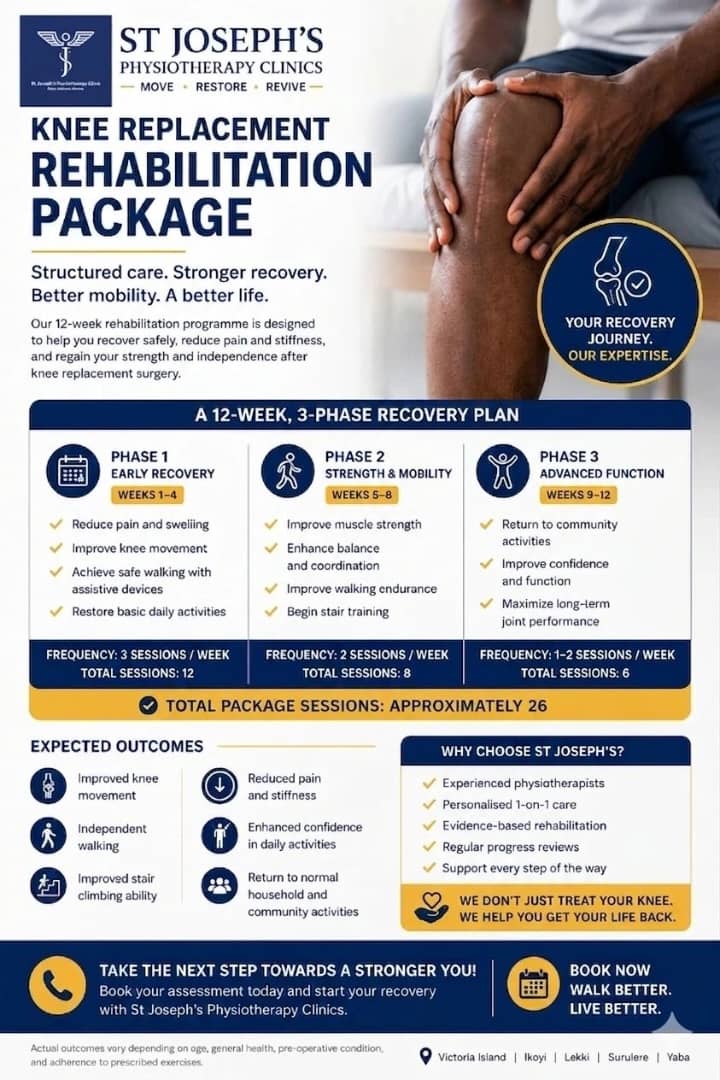
Complete Knee Replacement Rehabilitation Package in Lagos
Knee replacement surgery is a major step toward pain relief and improved mo…

NAMDA threatens strike over unpaid medical lecturers’ allowances
The Nigerian Association of Medical and Dental Academics (NAMDA) has warned…

Resident Doctors Signal End to Strike Threat After High-Level Talks with Gbajabiamila
The threat of a nationwide indefinite strike by the Nigerian Association of…
AMLSN Issues Strong Rejoinder to NAMDA on Public Service Establishment Matters
The Association of Medical Laboratory Scientists of Nigeria (AMLSN) has rel…