Dr. Mohammed. N. Salihu, Medical Director, National Orthopedic Hospital, Kano, is the fifth
indigenous, medical director of the hospital. Young, energetic and intelligent, he runs the hospital with a transformational agenda that connects, inspires and measures up to the challenges of the time.
In this interview in his office with Desmond Mgboh, he outlines why the management of the hospital desires to set up a Spinal Center. He also speaks about the challenges they face in this quest
Excerpts:
For a start, many of us have heard so much about the National Orthopedic Hospital, Dala, Kano State, but practically know little or nothing about its history. Could you shed more light this?
This hospital is one of the three orthopedic hospitals that belongs to the Federal Government of Nigeria - there is one in Lagos, another in Enugu and the one here in Dala Local Government Area of Kano State. Out of all the three, it is only the National Orthopedic Hospital, Kano that was purposely built as an orthopedic center. It was first commissioned· for services to humanity on the 21 of December, 1959 by then late Emir Sanusi- the grandfather of the present Emir of Kano- on behalf of the Sarduana Sokoto, the then Premier of Northern Nigeria.
At inception, the hospital was being managed by a consultant from the Royal College, London. Specifically, the first consultant, who headed the hospital, was called Dr. Braxton. He was the very first medical director, who ran the hospital from 1959. Then, they used to send in doctors from London to actually cover the hospital, while trying to train the locally based ones.
Around 1959 basically, they used to take care of only cold cases. Emergencies were being taken care of at the Murtala Mohammed Specialists Hospital by the same group of doctors that were here. They take emergencies there and they bring them finally to this hospital for definitive treatment. After him, the very first indigenous medical director that came up is Dr. Osas Osawoye, who incidentally is still very much alive and is living in Kano.
He did particularly very well by imbibing the modem technique of orthopedic treatment. He was the one who brought in the huge international company that is known as A. O International. They are those who are responsible for the manufacturing of materials needed for fixing of fractures and that, particularly, helped this hospital and put the hospital on a very good footing because today, the company, A.O International recognizes this hosital as a hospital that is up to standard, hospital that uses standard materials.
While other hospitaIs were struggling with materials, he put this hospital on a very good footing as far as instrumentation and achievement were concerned.
After him, the Late Professor Ernest Mbamali was seconded from Ahmadu Bello University Teaching Hospital to come here as a medical director. He concentrated whether as nurses or other health workers.
He did so well in that direction and this led digenous consultants during his time. The next medical director was Dr. Poopola. Dr Popoola contunued in thge lne of ProfessorMbamali in terms of extensive training, in terms of re-organization of our training structure. It was during his tenure that the Post Graduate College actually approved this hospital for the training of specialists in orthopedic; both from what we call the National College and the West African College of Surgery.
They were now getting' training in this hospital.
After him was the very first indigenous home- made and home- grown medical director, Dr Kabir Abubakar, who came in here as a junior resident and grew to the rank of the medical director. Since he knew most of the issues, he did well in the area of infrastructural development of the hospital. Quite a lot of the old structures were changed by him. He had the Consultant Block built. He built also a new Accident and Emergency Unit, and he also started this Administrative Block. So I happened to be the second home- grown medical doctor and just like Dr. Kabir Abubakar ,I also came in here as a very young man in 1996, when I was barely 26-years of age and then I grew up, through all the ranks, to eventually become the medical director.
.jpg)
You have slated the 21st of December, 2014 for your 55th anniversary. What exactly informed this project?
Since our inception, 21st December 1959 till date, we are going to be 55 years and we thought that anything that has been in existence for 55 years, we need to look back. What have we done rightly? What are the areas that we have not done too well? How can we make the institution a lot better, knowing fully well that this institution is providing services for the whole of Northern Nigeria i.e North West, North Central and the North East and certainly also, some neighboring countries- patients from Niger Republic, from Chad, from Cameroun and sometimes from even the Central African Republic? We needed
to look at the situation. How have we fared? Where are the areas that we have done well? And where are the other areas that we think we needed to improve? So, myself, my management team and the board, we decided to audit ourselves and then we realized that we are seriously lacking behind in terms of infrastructural development and then, in terms of meeting up with the standards of the Royal College.
London as it is today. Don't forget that when we started, doctors were coming from the Locyal College of London, bringing in their expertise and equipment. When we nowcompare ourselves today with Loyal College London, we saw that we have a very wide gap. So, myself and my management and the board of management agreed that we need to reduce that gap.
Since we started with the Loyal College, let us see how far we can move up to bridge that gap. That of course led us to look inward. We resolved that yes we need to upgrade some of our facilities. I tell . you that we still have facilities that were built since 1959 in this hospital. Some of them are still there, but doubtlessly, they are now obsolete. We still have equipment that were bought here during the Sardauna era, some of those-equipment are now obsolete. How do we go on? And then the third issue has to do with personnel- training. Well, it is in the area of training that I must say that we have done. very well.
Virtually, all the specialists that we have here have gone for one form of training or another- Germany, France, Britain.
So we are up-to -date when it comes to training. As I am talking to you now, we have four of our consultants outside. The areas we have not done too well are the areas of infrastructure and equipment. In view of this and in view of the dwindling economy of the' Federal Government- yes the Federal Government is seem to be doing very well, but they also have too many hospitals. The money is not coming the way it should be coming and therefore, we cannot get enough funds from the Federal Government to meet up with these two areas. We then decided, as part of our 55th anniversary activities, to lunch an endowment fund, to get the wealthy individuals from both within the country and outside to assist us with funds for us to be able to bring up the level of our infrastructure and equipment, to be able to meet up these two areas that we have nos-done too well. So that by 2015, I should be able to call you to say that we are very happy the way we are - in terms of training, our people are doing well, in terms infrastructure we have moved up and in terms of equipment, we have moved up too.
In particular, you just talked about the launch of an endowment fund as part of the anniversary celebrations.
But what exactly is the fund meant to achieve?
In particular, we are interested in what is called a Spinal Center. A Spinal Center is that center that takes care of those patients with back pains, patients who cannot walk because of spinal cord problems, patients who have had accidents and developed spinal cord injuries leading to their in- ability to use their legs or their hands or both. Why did we pencil down on this? In this whole country, today, the only Spinal Center that is available is at Enugu and it is owned by the missionaries. It is actually a few bedded structure that is also dilapi- dated today.
The only one(spinal unit) we seem to have in this hospital is just an eight bedded ward that is dedicated for spinal patients- Only eight beds that is dedicated for spinal patients and we received a minimum of about 25 patients per week requiring spinal services. So, how are we going to cope with the eight beds? For us to be able to give Nigerians a very good service, we should all note that back pain is a disease for everybody.
I believe some of you already have it, some of you would have it in time to come If you don't have it right now, it is only a matter of time, you will have it. It is such a widespread disease that is everywhere. So, we need to develop a centerthat is to specialize in the treatment of that particular back pain. Most Nigerians today are going outside the country to treat the problem and I want to tell you that sixty per cent of them go out because of back pains and spinal related problems.
(cuts) Sixty percent of .- ... ?
Yes, those of them going out for orthopedic cases are going out because of backache and spinal related injuries. So, If Nigerians would come to our aide and give us the fund to build a Spinal Center, an equipped Spinal Center, train personnel to treat this widespread ailment, we are going to reduce the figure of those who are going out for this treatment. And I am used to saying, it is always better for you to get these services in your own country, rather than go to anywhere else. I give you an example. If somebody goes out because he has a backache to India or to Egypt, yes he gets the surgery done, he comes back, but that is not the. end of it because with any ailment, once you finished the surgery, that is the beginning of the healing process.
That patient would be required to continue to see his doctors, to follow it up. Can you imagine a situation where we expect the patient to travel every month to India or to Egypt to see his doctor? But if we have the infrastructure, the facility, the technical knowhow in this hospital and he gets his surgery done here, he can come and see his doctor any day , any time and if there are issues, it can be easily followed up. So this is the reason why this management has penciled this all important Spinal Center, come 21st December, 2014. I want to assure Nigerians that we are going to make the best use of whatever fund that is released to the real aim of that particular id _ fund, which is to establish a very nice infrastructural base for a Spinal Center, equipped that Spinal Center to the level of what they have at the Royal College Hospital in London ..
What is the projected financial target of the endowment fund?
Well, the target of our endowment fund is just N700 million, which would help us built a proper infrastructure that is able to accommodate 45 patients, compared to the eight that we have right now. It would also give us a State of the Art including Magnetic Resonance Imagery (MRI).
Have you proposed this financial re-quest to the Federal Government?
And how did they take it? We have made this same request to the government, not even now, it has been made several years ago. You know that when you want to make request to the government, you apply for it in your budget. You put in so many things. And then, several other hospitals would put in their on requests, What I am saying is that it would be very difficult for the Federal Government to just give a single hospital N700 million- that is the budget of probably two or three hospitals in the country.
It is a project that is doable under Federal Government, but that would take us almost 10 years to build.
A typical example is the building we are in seated here. It was awarded by the Federal Government years back but it took some time to be completed. Yes, I must say that the Federal Government has been trying to fund us but they aIso have allowed us to do what is called " PPP" and also to solicit for support from philanthropists to come in and help, because at the end the day, whoever contributes his fund to assist our Spinal Center project has assisted humanity and the people we are serving.
By Desmond Mgboh, Kano
ABUJA: Training Schedule for Basic Life Support BLS, Pediatric Advanced Life Support (PALS), Advanced Cardiovascular Life Support ACLS, First Aid, CPR, AED
PORTHARCOURT: Training Schedule for Basic Life Support BLS, Pediatric Advanced Life Support (PALS), Advanced Cardiovascular Life Support ACLS, First Aid, CPR, AED
LAGOS: Training Schedule for Basic Life Support BLS, Pediatric Advanced Life Support (PALS), Advanced Cardiovascular Life Support ACLS, First Aid, CPR, AED
STOP paying for airtime and electricity, Let your phone pay its bills with ScreenT
You may also like
Comrade Lemii Christian Emerges Chairman of NANNM Rivers State Branch in Historic Victory
PORT HARCOURT, NIGERIA Following the long awaited National Association of N…

FG Supports Robotic Surgery Expansion to Reduce Medical Tourism
Nigeria is taking another step toward strengthening specialised healthcare …
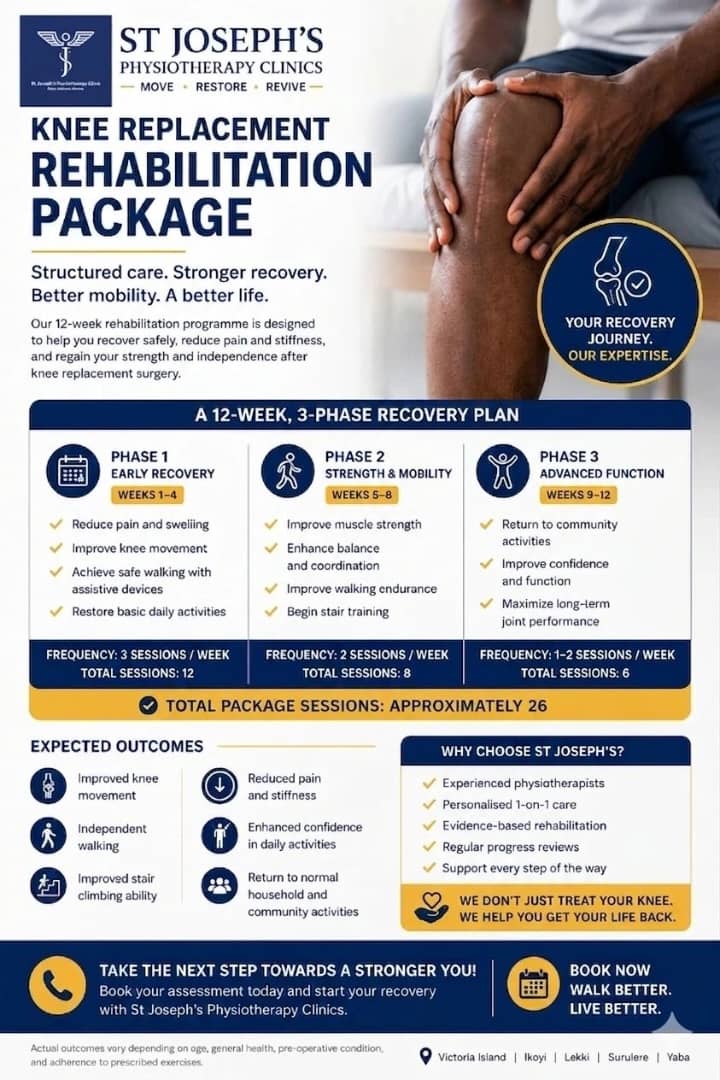
Complete Knee Replacement Rehabilitation Package in Lagos
Knee replacement surgery is a major step toward pain relief and improved mo…
NAMDA threatens strike over unpaid medical lecturers’ allowances
The Nigerian Association of Medical and Dental Academics (NAMDA) has warned…
Resident Doctors Signal End to Strike Threat After High-Level Talks with Gbajabiamila
The threat of a nationwide indefinite strike by the Nigerian Association of…