WITH increasing technology and innovation, surgerie, which normally are done by cutting patient’s abdomen are now being done through laparoscopic surgery, affording patients reduction in pains and hemorrhaging.
Laparoscopic surgery, also called minimal invasive surgery (MIS), bandaid surgery, or keyhole surgery, is a modern surgical technique in which operations are performed far from their location through small incisions (usually 0.5–1.5 cm) elsewhere in the body.
In many western countries and even Kenya, this method of surgery has since been the adopted mode of operation with just few hospitals in Nigeria keying-in to it.
As a result of this, Lagos University Teaching Hospital (LUTH) in partnership with West African College of Surgeos has held a workshop designed to train and retrain Nigerian doctors on how to safely do keyhole surgeries.
Held at LUTH’s Surgical Skills Centre, Idi-Araba, Lagos, surgical resident doctors and other specialists were taken through a successful live Laparoscopic surgery which was conducted in the hospital’s theatre and beamed on a projector to participating doctors while interacting with the surgeons.
The coordinator of the beamed surgical section and Chief of Surgery & Group Clinical Adviser, Lagoon Hospitals, Dr. Jimi Coker said that the purpose of the workshop is for those who are experts in the field to come and demonstrate to residents and young consultants how to do the keyhole operation safely.
He revealed that unlike Nigeria where many surgeons still conduct open surgeries, Kenyan surgeons do more keyholes and the need arises for Nigerian surgeons to upgrade and update their skills with keyhole surgery.
Jimi noted that the procedure offers patients less trauma, less time spending in hospital after surgery and less damage to the body.
He said: “for example, the gall bladder, when patients have gall stone with inflammation, the gall bladder needs to come out along with the gall stones. It is a small organ but to get to remove it, you need to make a very big hole in the tummy but now; you can do it through the keyhole method. But that requires expertise, it requires training and not everybody can do that; even if you are a surgeon, you may not have the skills and equipment to perform the procedure.”
Meanwhile, the Acting Chief Medical Director of LUTH, Prof. Chris Bode, said that the workshop was organised in need for Nigerian doctors to be in consonance with best practices in use all over the world.
According to him, “We cannot continue to send our patients abroad. We cannot continue to send even all our trainees abroad. We need to domesticate training and make it part of our culture here- advanced skills transfer, skills acquisition. If we believe in ourselves enough as a country, it is something we can easily do. It is not rocket science, it has been done in other places. So all you need will be the place, the equipment and the people to train and those willing to train. We have all that confluence here that is why we are doing that.”
Bode noted that the training is done through simulation stating that advanced training these days uses it and doctors have also started using it in practice of surgery.
He also said that it serves not only as a training, but also as a refresher course for doctors who already has the skills.
“It is not just doing it on life patients, we will be practicing it, and that is, we simulate it. In every aspect of advanced training these days people use simulation- in aviation for example, those who fly airplanes don’t have to crash airplanes before they learn how to fly; they use simulation. Doctors now use simulation to train and the practice of surgery.
“We train everybody because it is not only specialist doctors in training who should acquire these skills; we are also retraining those who already has these skills. It is a refresher course. But the theme of this workshop is to come together and brainstorm on how we can take this to the next level. What the challenges those who have been practicing it have met, their success stories, where we can take it to and what else we can do not only to break the glass silver but step up and get it to a higher level. That is the motivation,” he said.
He commended their partners, West African College of Surgeons who through their partnership, the hospital received equipments worth more than One million Euros from foreign partners.
In his words: “We must commend the enormous support given to us by Karl Storz, Covidien and even Ethicon in providing us with all these equipment.
By Kenechukwu Ezeonyejiaku and Onyinye Iyeke
ABUJA: Training Schedule for Basic Life Support BLS, Pediatric Advanced Life Support (PALS), Advanced Cardiovascular Life Support ACLS, First Aid, CPR, AED
PORTHARCOURT: Training Schedule for Basic Life Support BLS, Pediatric Advanced Life Support (PALS), Advanced Cardiovascular Life Support ACLS, First Aid, CPR, AED
LAGOS: Training Schedule for Basic Life Support BLS, Pediatric Advanced Life Support (PALS), Advanced Cardiovascular Life Support ACLS, First Aid, CPR, AED
STOP paying for airtime and electricity, Let your phone pay its bills with ScreenT
You may also like
Comrade Lemii Christian Emerges Chairman of NANNM Rivers State Branch in Historic Victory
PORT HARCOURT, NIGERIA Following the long awaited National Association of N…

FG Supports Robotic Surgery Expansion to Reduce Medical Tourism
Nigeria is taking another step toward strengthening specialised healthcare …
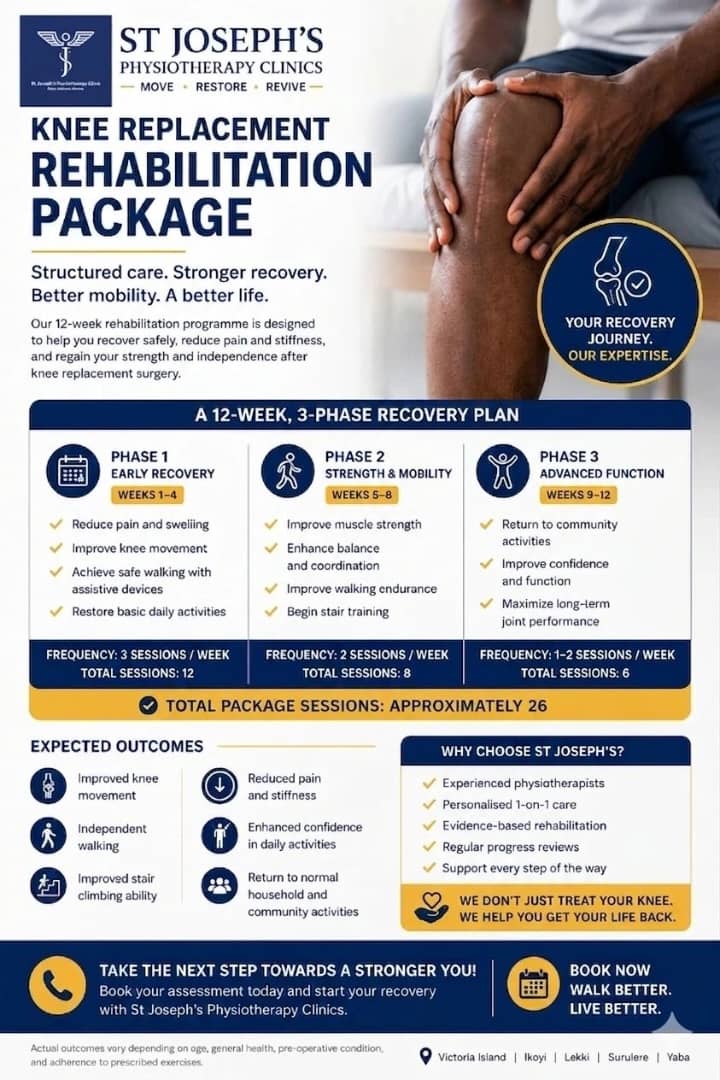
Complete Knee Replacement Rehabilitation Package in Lagos
Knee replacement surgery is a major step toward pain relief and improved mo…
NAMDA threatens strike over unpaid medical lecturers’ allowances
The Nigerian Association of Medical and Dental Academics (NAMDA) has warned…
Resident Doctors Signal End to Strike Threat After High-Level Talks with Gbajabiamila
The threat of a nationwide indefinite strike by the Nigerian Association of…