Prof Oluwole Ogundele of the Department of Archaelogy and Anthropology, University of Ibadan in Oyo State is worried that health challenges persist in the country despite increasing number of teaching hospitals. He wants government to pay due attention to the training of medical personnel.
Mankind and medicine are inseparable in a neat way. The holy alliance is of con-siderable antiquity understandably because the human body is prone among other things, to a myriad of infections and/or injuries as an in-dividual tries to explore and exploit the material and to a limited extent, spiritual world in which he lives.
These infections, injuries and ail-ments are not fixed once and for all, as man faces new problems, as-pirations and challenges through time and space. Medical attention ,prevents or combats these health challenges and/or problems. How-ever, new diseases and/or health problems are bound to occur be-cause of the ever-changing phenotypic and genotypic conditions.
These conditions arise from mod-ern ways of life and living. But for this to become a reality, all the main stakeholders must begin to proactively work together in order to free medical education in Nige-ria from the fetters of complacency and rigidity. Up to now, proactive ipeasures in this sector of our national life are a far cry.
Therefore, re-inventing medical training in the context of today's challenges, aspirations and expectations is a task that, must be accom-plished at all costs. It is a necessity a matter of utmost importance as opposed to an option. Health and development are inter-connected. For the sustenance of healthy life and living within the context of so-cial and material development, high-profile medical training and practice have to occupy a central position in our vocabularies of popular discourse.
It is against this backdrop that medical training including practice oh a sustainable scale gains its mi-evance or pivotal status. The west-ern ern form of medicine which has I continued to dominate the health landscape of Nigeria since the dawn 1 Nigeria's entanglements with ,urope more than four hundred years ago is the focus of this article. a In other words, the indigenous iknowledge system on medicine vis-a-vis its barbarisation and im-prisonment by the Western medical practice through the lens of limited European and to some limited degree, North American intellectual oligarchy is a topic for another time.
Nigeria became a colony of Britain between August 1861 and Octo-ber 1960 when the former regained its freedom although largely on pa-ir from the latter. Medical tram-lng started at the University Col-ege Ibadan in the southwestern egion of the country in 1948. Department of Medicine here was one Rof the ten foundation departments of the Faculty of Medicine. The university was committed to the training of people especially young Nigerians in the field of medicine. On August, 1980, the University of Ibadan, Faculty of Medicine meta-morphosed into College of Medi-cine. Training was very rigorous with excellent facilities and robust opportunities for housemanship after students had successfully com-pleted their final examinations.
Today, at least 15 federal univer-sities are offering medicine programmes. These include: Obafemi Awolowo University, Ile-Ife (formerly known and called University of Ife); University of Ni-geria, Nsukka; Ahmadu Bello Uni-versity, Zaria; University of Benin, Benin-City; University of Calabar, Calabar; University of Lagos, Lagos; University of Maiduguri, Maiduguri; University of Port Harcourt, Port Harcourt; University of Ilorin, Ilorin and Uthman Danfodio University, Sokoto.
At the state level, at least 13 uni-versities are running programmes in medicine. They include: Ladoke Akintola University of Technology, Ogbomoso; Lagos State University, Ojoo, Lagos; Ekiti State University, Ado-Ekiti; Imo State University, Owerri; Delta State University; Anambra State University and Kaduna State University.
On the other hand, five privately owned universities are offering programmes in medicine. They are: Igbinedion University, Okada, Benin City; Babcock University, Ilishan-Remo; Bowen University, Iwo; Afe Babalola University, Ado-Ekiti and Madonna University, Okija. All in all, Nigeria today can boast of 33 institutions offering medicine. Eight out of these uni-versities are running State in dentistry. Lagos State Univer-sity is the only non-federal institu-tion out of them.
All the 33 universities offering medicine have at least a total of 2,700 students as enrollees on a yearly basis. This is a huge num-ber although not too much for Ni-geria — a country with a population. of 200 million or thereabouts. Apart from this huge human population which is second to none in the black world, Nigeria has extraordinary natural resources and an enviable human capital needed for sustain-able development in all its ramifi-cations. But sadly enough, these abundant resources are yet to be translated into meaningful projects for the betterment of the human condition particularly in the area of robust health care delivery as well as health management.
I will try to illustrate this sorry state of affairs generally in Nigeria within the framework of housemanship for fresh medical graduates. After five or six years of medical training, every gradu-ate has to do a mandatory housemanship job in a public hos-pital before going to participate in the one-year National Youth Ser-vice Corps (NYSC) scheme. No fresh medical doctor or dentist can skip this stage of practical exposure (housemanship). The bottom line is to further develop the skills of these young doctors beyond their school environment.
It is a legitimate attempt to strike a balance between knowledge and wisdom otherwise called knowl-edge applications. They cannot af-ford to be mediocre personnel, un-derstandably because they are go-ing to be dealing with humans in our rural, semi-urban and urban settlements and even beyond the shores of Nigeria.
They are Nigeria's ambassadors at different levels of social and pro-fessional engagement. This sce-nario shows that thoroughgoing education must necessarily take centre stage in the scheme of things. Nobody can contest this reality. However, the main stakeholders such as the Medical and Dental Council of Nigeria (MDCN), Nige-rian Medical Association (NMA) and the management of each uni-versity have to begin to do a re-think of aspects of the current medi-cal knowledge productions.
 Indeed, good policy decisions and targetted interventions of the above stakeholders among other categories of people have to derive from adequate appraisal, reappraisal, appreciation, understand-ing and appropriation of the fast-shrinking space for housemanship in our public hospitals (state and federal). The available public hos-pitals have no sufficient space to absorb the huge numbers of medi-cal doctors.and dentists being pro-duced yearly from the Nigerian medical schools.
 It follows from the above that if the space for housemanship in the state and federal hospitals across the country is becoming too small, then all stakeholders particularly the key players must not shrink from proachvity in several senses.
Even the available public hospi-tals in most cases, are not ready to engage the services of these young men and ladies for the one-year housemanship usually due to the popular but unwarranted rhetoric of tight budgetary positions. This is in addition to the fact that good quality health care delivery is yet to be a top priority of the political class.
All the above excuses are a reflection of a very low standard of pa-triotism in the face of rampant greed or materialism of modern Nigerian society. This shrinking space will lead to cut-throat com-petitions among the newly trained doctors as they jostle for positions in the few public hospitals that are ready to take them.
One concomitant effect of this situ-ation is an increase in sharp prac-tices at different quarters or levels of social and professional engage-ment. Thus, for example, those in charge of recruiting or employing fresh medical doctors and dentists become 'super-humans' or arrogant managers of human capital as nu-merous candidates and sometimes, their wards or parents beg for space for housemanship.
This edifice called Nigeria must not collapse! Nigerians and their friends within and outside the coun-try must not continue to look the other way as innocent fresh medi-cal graduates and their ,parents re, main at the mercy of 'saturated' housemanship space and mindless, parochial, avaricious stakeholders. These Nigerians are already feed-ing fat on the imbalance or disequi-librium in the system bereft of proactivity.
This situation creates a corrupt-ible environment that is inimical to profound medical knowledge productions and by extension, the future of Nigeria. This is an ugly development that never existed in the past, when only six or seven universities were offering medi-cine in the country.
Today, there are many universi-ties running the programme and yet there is no corresponding in-crease in public hospitals. Simi-larly, no evidence of monumental expansion of the available ones as endemic corruption walks on all fours on our collective landscape called Nigeria. Certainly, there is fire on the mountain! Therefore, the box that houses our definitional and conceptual perspectives of medical training and education has to be enlarged so that our products can remain afloat the stream of modern life and living.
Some new horizons must be opened up in order to nip a deep crisis in medical training in the bud in Nigeria. The idea of limiting housemanship space to only public hospitals is no doubt moribund, given the enormity of the number of doctors produced annually.
It is very unrealistic and equally capable of engendering greater corruption and other negative atti-tudes that are inimical to the interests of the society.
Change is inevitable! Corruption at the top in the Nigerian medical world would get bigger and more monstrous in the face of desperation by fresh medical doctors who have to mandatorily do their housemanship latest 12 months after induction or else they go back to their schools to retake the dreaded final examinations. This shows that housemanship as a com-pulsory facet of the entire medical training process is time-bound.
Therefore, it is unlike when a can-didate is looking for a job in a ten-sion-less manner. It is suggested here, that well equipped private hospitals be identified across the country. Many of such health cen-tres are located in different parts of Nigeria. Government can encour-age them to absorb some of these fresh medical doctors. for the man-datory one-year housemanship.
They would certainly gain some critical knowledge and experiences needed to boost their confidence for local and international engage-ments. These possibilities have the capacity to reduce to the barest minimum the current avoidable stresses and strains of young medi-cal doctors struggling to do their housemanship in public hospitals.
Indeed, private hospitals with standard facilities must be seen as partners in progress with respect to the provision of high-profile practical training for students. Therefore, state and federal governments cannot afford to com-pletely or near-completely keep them (private hospitals) at bay. There must be some amount of commitment to private hospitals in the overall interest of societal growth. It seems to me that the cur-rent scenario about housemanship programmes, is a robust testament to the need for governments at all levels to begin to dance creatively with private hospitals.
Proactivity has to be put on the front burner of our operation as we chart the pathways of sustainable health care development and man-agement including training of medical personnel in Nigeria.
Aside from the above, more pub-lic hospitals are needed particularly in the rural areas of the country. But unfortunately, this key area of life remains on the bottom rung of Nigeria's development agenda. This is largely because the political class has unfettered access to good health care systems outside the shores of Nigeria.
Such an attitude is embedded in immorality and primordial men-tality. New winds of change must begin to blow. These winds have to blow out the injustice, greed and self-indulgence in our collective thoughts cape. This leads us to the sphere of infrastructural facilities such as motorable roads, power sup-. plies and portable water. Rural de-velopment would encourage medi-cal doctors to live in our rural settlements without any regret. It also has the capacity to reduce the current rural-urban migrations with all their inherent security implication.
Source: The Nation News
ABUJA: Training Schedule for Basic Life Support BLS, Pediatric Advanced Life Support (PALS), Advanced Cardiovascular Life Support ACLS, First Aid, CPR, AED
PORTHARCOURT: Training Schedule for Basic Life Support BLS, Pediatric Advanced Life Support (PALS), Advanced Cardiovascular Life Support ACLS, First Aid, CPR, AED
LAGOS: Training Schedule for Basic Life Support BLS, Pediatric Advanced Life Support (PALS), Advanced Cardiovascular Life Support ACLS, First Aid, CPR, AED
STOP paying for airtime and electricity, Let your phone pay its bills with ScreenT
You may also like
Comrade Lemii Christian Emerges Chairman of NANNM Rivers State Branch in Historic Victory
PORT HARCOURT, NIGERIA Following the long awaited National Association of N…

FG Supports Robotic Surgery Expansion to Reduce Medical Tourism
Nigeria is taking another step toward strengthening specialised healthcare …
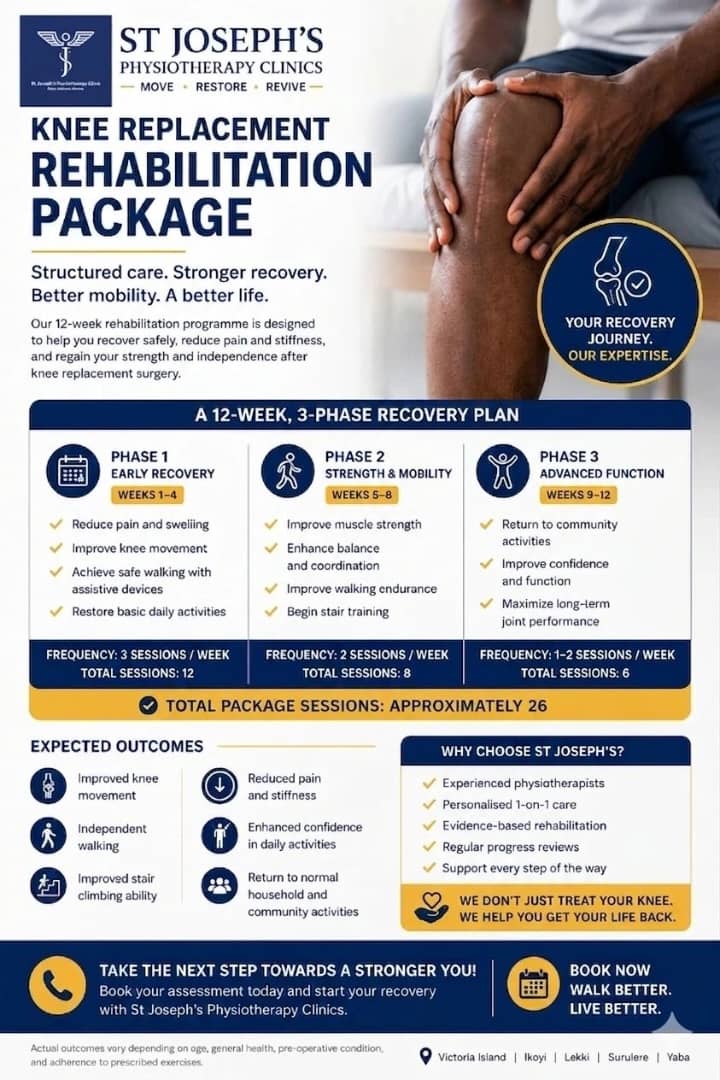
Complete Knee Replacement Rehabilitation Package in Lagos
Knee replacement surgery is a major step toward pain relief and improved mo…

NAMDA threatens strike over unpaid medical lecturers’ allowances
The Nigerian Association of Medical and Dental Academics (NAMDA) has warned…

Resident Doctors Signal End to Strike Threat After High-Level Talks with Gbajabiamila
The threat of a nationwide indefinite strike by the Nigerian Association of…