A Rejoinder to the Communique of the College Of Nigeria Pathologists 13th Annual Conference and General Meeting
This rejoinder is aimed at clarifying and elaborating on the sundry and important issues raised in the above referenced communique published on page 39 of Daily Trust newspaper edition of Friday, January 18, 2019. This issue put forward in the communiqué are incidental to the Nigeria health Sector, and by extension the safety of the health – seeking presented in the communiqué by the College of Nigerian pathologists (CNP) are tolerable, we, nonetheless, cannot allow the several calculated misinformation so presented go unchallenged.
.jpg)
The issues in question and our reactions are as follows:
a) On Pathology Residency Training
- All along, we had concluded that Nigerian Pathologists are immune from the problems bedeviling healthcare professionals, particularly in the public sector, one of which is the lacuna in their career development and progression.
- This perspective derives from the evidences available that the current leadership of the college of Nigerian pathologists are the spanner in the works to the progress of other healthcare professions and professionals.
- The CNP president in particular maintains a career – long record of arrogant posture towards other health professions or professionals who challenge him or complain about the wrong doings of doctors in headship positions in Public Health Institutions.
- To us, nothing is so unimaginable, or, can be more laughable than CNP’s lamentation that “the pathology discipline is worst affected” of “unimaginable frustration” due to “refusal or reluctance of hospital managements to fill numerous existing vacancies for residency training in almost all the accredited institutions in Nigerian”.
- Clearly, the CNP statement is a self-indictment of Nigerian doctors as bad managers of our health institutions.
- The accredited health institutions CNP referred to, which offer residency training, are headed by doctors who are either medical directors or Chief Medical Directors (lately mostly pathologists).
- Thus, if they (doctors) are now extending to other doctors (pathologists) the frustrations which they usually in collaboration mete out to other health professions we consider it rather academic a case drug eating drug and so be it.
- Our position:- Government must swiftly change the hardship of the health institutions and offer same to the right professionals, that is to hospital administrators and hospital secretaries. When that happens, a level playing ground will be provided for those who have reason to pursue post graduate training, either primarily as doctors, or medical laboratory scientists, or pharmacists, or any other member of the healthcare profession.
b) On poor state of clinical laboratories
- CNP asserts that “Nigeria’s Clinical Laboratory System is embarrassingly suboptimal in performance due to lack of re-training of staff, absence of quality systems and practices, obsolete and dysfunctional infrastructure and equipment and the lack of political will to do what is right to align clinical laboratory practices with global standards.
- Agreed. But regrettably, CNP failed to confess that pathologists are also the problem. How so? Sub-optimal performance of our clinical laboratory system is also due to inefficiency in the managerial know – how of the self acclaimed headship in laboratories.
- Clinical laboratories in most federal hospitals (teaching hospitals, and federal medical centres) where particularly members of the college of Nigerian pathologists have entrenched themselves are today in the worst of conditions also because Nigeria pathologists who have seized the headship of these laboratories insist on doing what they are (1) not trained to do, and (2) not licensed to do.
- A pathologists is a clinician whose dully, primarily, is about caring for patients, not taking charge and or, superintending medical laboratory testing.
- Since 1972, the Federal Government gave administrative role of clinical laboratories to medical laboratory scientists (MLS) several circulars of government up to 2003 also gave that responsibility to MLS.
- Notwithstanding the law, the rulings or orders of courts, today, doctors have by power and influence appropriated hegemony of our medical laboratories in the public sector, and run them without let or hindrance. But, with what results? Examples in this respect abound, but let us consider just one.
- At the National Hospital Abuja where the president of CNP, Dr. Kenneth Ireogbu, is the head, poor clinical laboratory services is the practice, all because Dr. Ireogbu does not understand how laboratories work optimally, hence the MLS discipline is not his calling or training. Till date, Dr. Ireogbu has frustrated the institutionalization of laboratory quality management system in the medical laboratories in National Hospital Abuja, which are under his purview.
- The Maitama District Hospital Laboratory and the National Hospital Laboratory offers the opportunity to make a distinction between the qualities of services Laboratories in each of the hospitals provide.
- Whereas, the Maitama District Hospital has long institutionalized laboratory quality management system, enrolled in the processes and sacred four- star rating in the accreditation by the MLSCN and SANAS of South Africa, the National Hospital where Dr. Ireogbu holds sway is yet to sign – on
- In the above situation, whose “will” is “lacking to do what is right to align clinical laboratory practices with global standards”? And how can CNP’s “quality systems and practice” so succeed? And how can “quality systems and practice” be achieved in the laboratories in government health institutions, which are under undue administrative interference, occasioned by highly repressive professional malevolency by doctors?
- Private hospitals on the other hand are quality of maintaining ramshackle places which they call laboratories. They employ quacks and charlatans; their doctors also snubbed the MLSCN routine inspection of their laboratories. With school drop-outs employed to provide laboratory services, how would results emanating from the laboratories not be “spurious”?
c) Our efforts
- Last year (2018), the Medical Laboratory Science Council of Nigeria (NLSCN) carried out nationwide inspections of laboratories to determine the level of their compliance with set national standards, but doctors frustrated the inspection exercise by hindering the MLSCN team from accessing the laboratories in their private clinics and hospitals.
- Unequivocally, Nigerian doctors are responsible for the spurious poor quality result that patients get today. On these grounds, the CNP should indict its members, and stop the old antics of shifting the blame.
- Our position: We call on the Nigerian Medical Association (NMA) the Medical and Dental Consultants Association of Nigeria (MDCAN) and CNP to allow sanitization of clinical or medical laboratories (synonyms) wherever situated.
- Until Nigerian pathologists give way and allow full-scale institutionalization of laboratory quality management, the laboratories where they have entranced themselves, and gagged some medical laboratory scientists, will not operate optimally.
- On Training Laboratory Personnel: The CNP must be up to some pranks. A Bill for establishing National Postgraduate College of Medical Laboratory Science (NPCMLS) is pending before the National Assembly, with provision for the training and retraining why is CNP now turning round to campaign for the need for training and retaining of medical laboratory staff?
- If it is sincere and truly determined, the CNP should first take a concrete step by granting official endorsement to the till for thee NPGCMLS, not by the mere proclamation it made on the page of a newspaper.
d) On Public Private Partnership
- CNP’s call on government to remove every obstacle hindering smooth and effective implementation of Public Private Partnership (PPP) model of healthcare pathologists to speak for us the MLS, saying “PPP is the reasonable way to upgrade the quality of equipment, infrastructure and quality of service in our clinical laboratories.
- We are not opposed to the PPP arrangement provided in the government template, but the way and manner the current PPP scheme is being implemented is the source of our worry.
- The current PPP arrangement is a play by Nigerian doctors to merely exploit the system and take away healthcare services from the reach of the poor – evocative of the manner of Health Maintenance Organization (HMO) in operation in Nigeria, whereby about 90% of the HMO’s are owned only by doctors, which is the albatross of the NHIS.
- We have condemned the PPP arrangement as operated in most Federal Health Institutions in the time past. The scheme will make healthcare inaccessible and unaffordable to the average man on the street.
- As it is now, the PPP scheme is rather shortchanging the citizens and has become and avenue for some CMDs/MDs to gratify family members and associates as well as a conduit pipe for exploiting the federal government of expected accruable revenue from the laboratory.
- The question deserving immediate answer is: What is the justification for privatizing a medical laboratory for instance, which was operated at a cost of
N20 million and a return ofN200 million under government ownership? What has government achieved privatizing the medical laboratories in some Federal Health Institutions? The PPP scheme is enriching few individuals at whose detriment? Today, medical laboratory services in such facilities are at a much higher cost. - Besides, PPP compromises on standards. For example, most of the private providers of medical laboratory services in Federal Health Institutions are (1) Not registered anywhere to provide such services and (2) Do not comply with any form of regulations to provide such services. If the hospitals were still run by government, the rues, of course, will apply.
- It must be conceded that the current PPP has led to the sack or retrenchment of many members of the world force in most government hospitals, not just medical laboratory scientists.
- But a veracious PPP model (including wet lease) exist which stipulates that the private sector can intervenes and provide one or more services a hospital is not able to offer, build capacity of staff in that regard, and after a period, bequeath it to the hospital. But the opposite is what is in operation; with high degree exploitation of our common wealth, thereby shortchanging the country and exposing citizenry to more hardship. The PPP option in operation is not a sustainable alternative. It is marred by fraud. It is most unacceptable, it should be independently exalted and stopped forthwith.
e) On Service Areas Revolving Fund in Hospitals
- The CNP’s call on governments to direct the establishment of full and truly revolving fund where desirable, to enhance service delivery especially in clinical laboratories, pharmacies, and radiology; and increase funding to health institutions to minimize interference in the administration of Revolving Fund: Good suggestion.
- Nonetheless, we want it on record that Drug Revolving Fund and Medical Laboratory Services Revolving Fund existed in some hospitals, but CMDs’ and the MDs’ stubborn interference in the administration of revolving funds scuttled the scheme.
- Doctors are not qualified to manage revolving funds. Logistic Supply Chain Management, which is the core area of training for Medical Laboratory Scientists and Pharmacists, is the prerequisite for managing revolving schemes.
- But CMDs and MDs, instead, appointed doctors to head all the various revolving funds’ committees. The cause of interference, chiefly, was pecuniary, from procurements. But how well did this go?
- The doctor – managed revolving fund, as it were, constantly failed to break even; multiple cases of fraud surfaced, and as a result, both the drug revolving scheme and the medical laboratory service revolving scheme collapsed.
- Our Stand: If public service revolving fund schemes must be reintroduced, to forestall destroying the noble scheme again, government must not allow doctors appropriates headship of the committees. Pharmacists/Medical Laboratory scientists must take charge of their respective committees.
f) On Private Practice and the Law
- The CNP’s call on government to deal with the issue of conflicts of interest by government employed doctors and other health personnel engaged in private practice:
- Agreed. But Dr. Ireogbu and his colleagues call for outright withdrawal of the Extramural Practice: Circular, if anything withdrawal of the extramural Practice Circular is thee only way forward. It will free the health sector from the deadly system emasculating it; a dangerous system the government has foisted on Nigerians, which is as inimical to the Nigerian health sector as the obnoxious Decree 10 of 1985.
- Nigerian doctors have used Private Practice as an opportunity to destroy the lives of many patients. With the extramural circular, government employed doctors consider themselves as the “civil servants above the law”.
- Who gave them the leeway? The Government of course. On one hand, the Public Service Rules declares that those in public employment must not do business. On the other hand, government via the extramural practice circular, provides government emboldened them to excesses of even felonious nature. For instance, a poor health seeking citizen goes to a public hospital for treatment; the government employed doctor instead directs thee person to a private hospital where that doctor maintains a Private Practice engagement. That is the prevailing situation in our public hospitals.
g) On the Listing of Clinical Laboratory Professionals and Staff
- CNP’s listing of clinical laboratory professionals and staff is misleading. Where in the world is the clinical laboratory made up of all the sundry cadre / personnel categories mentioned? What does Dr. Ireogbu and his colleagues really want to achieve? We know who the core Medical Laboratory Professionals are as enunciated in the Schemes of Service, and as provided by Act cap M25 LFN 2004.
- Dr. Ireogbu and his colleagues want “peace and order” to “prevail”, and for “everyone to be satisfied” and “playing their traditional roles and responsibilities with no play to subvert or supplant the other”.
- Here are titles of government documents and circulars that prescribe MLS roles and responsibilities for CNP’s consideration: (1) the 1972 scheme of service (2) the 1979 scheme of service (3) the 2001 scheme o service (4) the 2003 scheme of service as published page 124 (5) the Act Cap M25 LFN 2004 (6) The National Medical Laboratory Services Policy 2007 all define the traditional roles of the medical laboratory scientists. And ISO 15189 is the international standard for medical or clinical laboratory.
h) On Prevalence of Dubious Laboratory Results
- Dr. Ireogbu and his colleagues should concern themselves with medical quackery in Nigeria. That is what they have a charter to do. It is not their behest to talk about “dubious laboratory results” and thereby use the opportunity to misconstrue issues. We are committed to patients and safety.
- We want it on record that Nigerian doctors are behind the prevalence of typhoid, malaria, and salmonella reporting. Laboratories planted in private clinics by doctors are usually manned by charlatans and quacks, and generate the dubious results referenced by CNP.
- We challenge CNP to make public any “dubious” result emanating from a licensed and registered MLS, such dubious results can only come from standard places called medical laboratories located in private hospitals.
- In 2018, the Medical Laboratory Science Council of Nigeria (MLSCN) conducted a comprehensive inspection using the WHO and FMOH amended checklist template in not less than 16 states of the country. The process was to sanitize medical laboratories in order to see the level of compliance with the checklist and the institutionalization of laboratory quality management systems in both the public and private laboratories.
- The state governments and commissioners of health endorsed the MLSCN inspection visits. But Nigerian doctors, incited by Dr. Ireogbu and the CNP, obstructed members of the MLSCN at duty by physically barring them from gaining access to laboratories in private hospital and clinks.
- By the laws of Nigeria, and by global standards, the MLSCN is supposed to have unfettered access to medical laboratories, wherever situated, even in a doctor’s bedroom.
- We are appealing to Nigerians to prevail on all private hospital owners and managers of public health institutions to allow MLSCN to do their duty.
- It is not the duty of the Medical and Dental Council of Nigerian to regulate medical practitioners in Nigeria. Moreover, the law does not empower MDCN to regulate facilities. Regulation of facilities owned by clinicians in private hospitals has long been ceded to States” Ministry of Health, not MDCN. If MDCN need amendment to that law to so empower it, they should follow due process.
- We are not unaware of the ongoing clandestine move by doctors to done major provision surreptitious establishment or amendment till. The regulation of medical and clinical laboratories is the duty of the MLSCN. Anybody calling for otherwise is only fostering quackery on the system.
i) On National Health Policy Direction and the Effect of Overreaching Agenda of Foreign Funders / Development Partners.
- It is our considered view that Funders and Development Partners are commended, not unduly criticized. Nigeria’s current reassuring benchmarks in TB. Malaria, HIV control and the much anticipated exit of Nigeria from the group Polio academic countries are all due to the roles played by funders/development partners (In 2018 alone, $92M for Nigeria HIV/AIDS indicator and impact survey (NAIIS). The accreditation status secured by some medical laboratories in public health institutions in Nigeria are also largely due to contributions by funders/development partners.
- Facts speak for themselves. But the point that seems to be lost on the CNP and Dr. Ireobgu is that they have not taken any lesson from their past habit trying to influence events.
- Dr. Ireogbu will be well advised to take a look back at when funders / development partners first arrived. Nigerian doctors were the first to integrate with them, and introduced to them what the doctors termed “Task Shifting” which promoted recruitment of secondary school dropouts to provide HIV testing, Malaria testing and others, by the roadsides, particularly in the HIV intervention programme.
- The Association of Medical Laboratory Scientist of Nigeria (AMLSN), halted the wrong initiative (Task shifting), and insisted on compliance with the extant regulations. Funders/Development partners who complied, commenced placement of qualified persons in the processes of medical laboratory testing, dispensing of drugs, and in the overall logistic management.
- Today, controlling funders’ medical laboratory specific functions and other medical laboratory related spheres of influence, the MLS profession have found its nice in the alliance with Development partners, but Dr. Ireogbu and the CNP are not only jealous and bitter, they have resorted to the “Pull him down syndrome” that is the manifest truth.
- Our contention: part of why funders/development partners are foot ragging on giving support to Nigeria is because our country does not have requisite on giving support to Nigeria is because our country does not have requisite medical laboratory services structure in the Federal Ministry of Health (FMOH) as is the case cross the global. Such interventions like the AIDs, TB, and Malaria (ATM), are usually coordinated from the FMOH has deliberately (by the sledge of hand of Nigerian doctors) or by sheer lack of knowledge refused to establish the department or directorate of medical laboratory services in the FMOH to coordinate these activities. This is one of the issues the NLTWG has addressed and made useful recommendations.
j) On the National Laboratory Technical Working Group
- The CNP’s call for immediate dissolution and reconstitution of the NLTWG with a view to ensuring that all professionals in clinical laboratory practice are adequately and fairly represented is misplaced, misleading, and done in bad faith.
- We, MLS have need for a National Laboratory (not “CLINICAL”) Technical working group (NLTWG), and the Federal Ministry of Health (TMOH) should be commended to have established it. The FMOH visible support of the NLTWG affirms government’s policy thrust of encouraging partnership towards providing better health services to Nigerians.
- Yes, MLS constitution 80% of the membership of the NLTWG, and rightly so because the number is limited strictly to those whose schedule is in the medical laboratory. The 20% allowance accommodates even Nigerian doctors and veterinarians.
- The Chairman of the committee is a known and respected professor, Oyewole Tomori (a veterinarian). He is a man of impeachable character, who has never been associated with failure. So how “adequately and fairly represented” does the CNP want the NLTWG to be?
- The CNP made various representations in thee said communiqué, which we believe re intended to malign and cast doubts on the integrity of foreign funders and development partners. One of such of the claim that the development partners are “skewing policies and actions”, as well as “instigating and sustaining crises”, it is not our brief to defend them.
- But the CNP call for dissolution and reconstitution of the NLTWG is revealing of pathologists’ desperateness to hijack any system at all and, as it is in their character, destroy it, not considering any negative consequences on the health of Nigerians.
- We urge the Honourable of Health to give more support to the NLTWG, and implement fully the recommendations made by NLTWG towards improving the country’s low health profile which, currently, Nigeria is in 188th and of 192nd position in the world, and 52nd out of 54th in Africa.
k) On the Law Courts and Clinical Laboratory practice
- We would have been pleased that in large measure, CNP, too, laments: (1) that the health system, particularly in the hospitals and clinic, is not the place for unnecessary self aggrandizement, inordinate and life threatening autonomy and experimentation on the lives of people”. We would also have been pleased with CNP’s call on (2) “all pathologists across the country to practice within the confines of professional codes of conduct and operational guidelines as clearly defined in the relevant documents of the Medical and Dental Council Nigeria, and in line with international best practices”.
- But, when CNP urged government to (1) “implement the recommendation in the Yayale Ahmed Committee report and put and end to multiplicity of lawsuits in courts including but not limited to professional job evaluation, role delineation and establishment of clear lines of authority or organogram according to international best practices obtainable in nations with high performing health system”, we had to part company with CNP because it became clear that the whole above declarations, are hemmed in irony!
- Our response: We, of course, have already expressed our position, for the umpteenth time, on the Yayale Ahmed report, and that position has not altered: the performance of medical laboratory tests, the administration and the operation of a medical laboratory, including the supervision of laboratory personnel and signing of test results and reports are not activities that constitute the practices of medicine. And, there are numerous court judgments today in support of this position in Nigeria.
- It is rather unfortunate that under the auspices of the Federal Ministry of Health, the trio: Thee College of Nigerian Pathologists and the Medical and Dental Consultants Association of Nigeria (MDCAN), inclusive of the Nigerian medical Association (NMA) even with the extant rules and laws and statute supporting us – are still hell – bent at using their vantage political and administrative positions to wreak havoc on the development and practice of Medical Laboratory Science in Nigeria.
- Modern health care delivery is a multi-disciplinary work involving a team of professions. But doctors (pathologists in particular) have usurped the administration and operation of medical laboratories in public health institutions in Nigeria.
- Trying to subordinate and subdue the Medical Laboratory Science profession in Nigeria for egocentric reasons clearly reflects the height of pathologists “self-aggrandizement” and “inordinate” ambition for “autonomy”.
- The abdication of thee defined duties of doctors (mainly pathologists) to usurp the prescribed roles and duties of Medical Laboratory Scientist including the signing of laboratory reports for tests they did not perform (PLAGIARISM – appropriating the intellectual privileges and rights of work not done) is a dangerous exercise of “experimentation on the lives of people” by pathologists, not Medical Laboratory Scientists.
- The CNP and its president, Dr. Ierogbu’s claim that “the core medical professional role of designation and administration are not issues for legal determination but prerogative of the employer informed from global best practices” is wrong, insincere, and outrageous, to say the least.
- First, the medical profession of which Dr. Ireogbu is a practitioner was established in Nigeria under Act cap MBLFN 2004, derivable from a legal framework. Second, the arm with the inferable duty and functional mandate to interpret laws is none other than the judiciary, and it does so through the processes of court. Plaintiff.
- Fourth, as of this writing, besides the numerous pending appeals field by NMA, MDCAN and CNP at the Court of Appeal, is the latest of thee case of this kind in court in Nigeria with Suite No. FHC/ABJ/CS/559/2018 filed in May 2018, by the Medical and Dental Consultants of Nigeria against every other health professional in Nigeria. The Attorney General of the Federation, the Senate of the Federal Republic, the House of Representatives, and the National University Commission are joined in the suit. Every healthcare professional in Nigeria is also joined in the suit. All the exhibits in the said suit were supplied and countersigned by Dr. Ireogbu.
- After berating the courts and the judges, instituting frivolous suits against regulatory agencies and health professionals in Nigeria, why reverse now to advice else should the MLS resort to?
- You disparaged the law, raped the law, violated the law; extant rules and laws and statute and does not want your victim to go to court. For goodness sake, the court, we all know, is the last hope of the down trodden.
Ifeanyichukwu Casmir Ifeanyi Cajetan, Ph.D., MLS (MLSCN).
National publicity Secretary
For: Association of Medical Laboratory Scientists of Nigeria (AMLSN)
You may also like
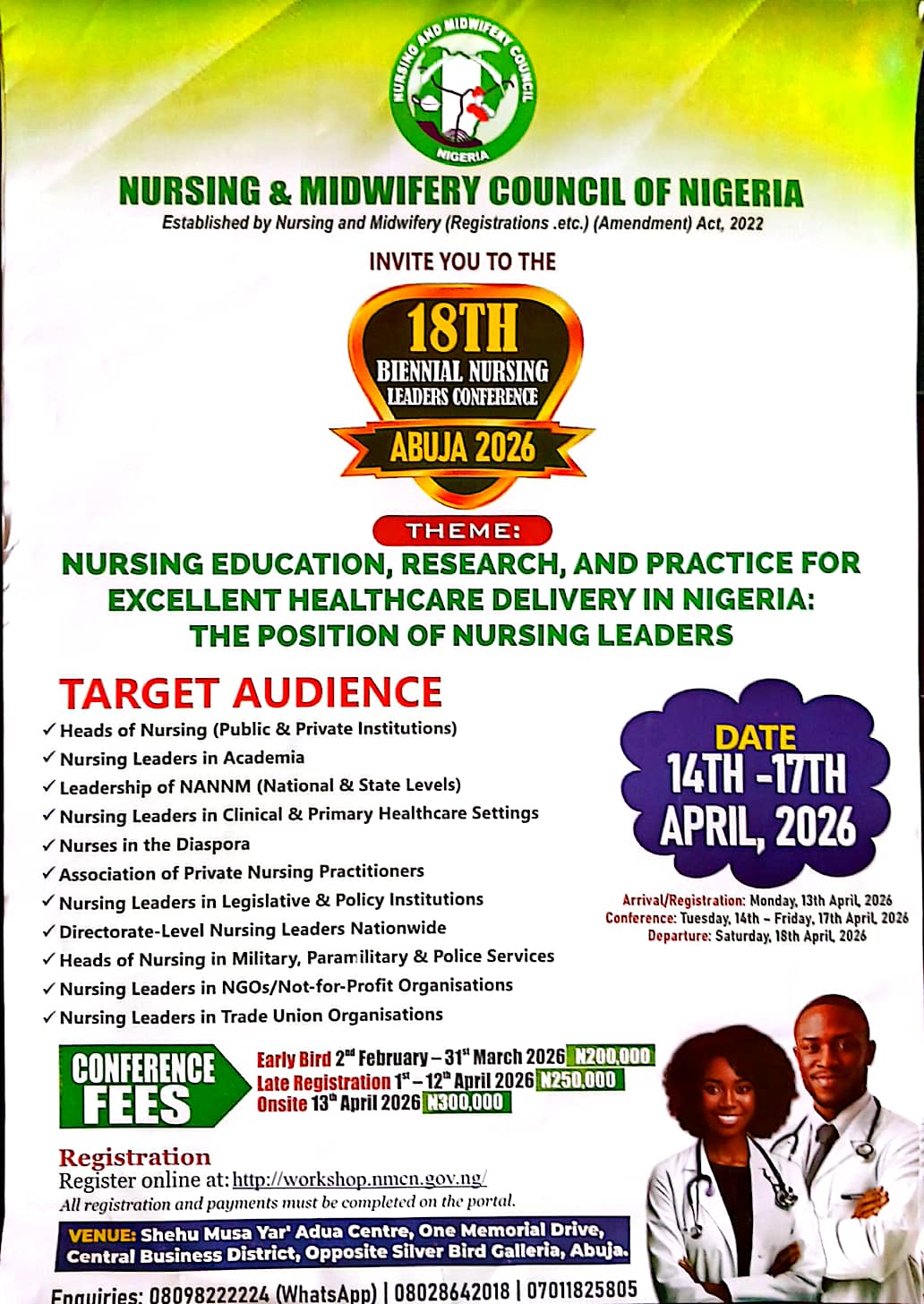
Nursing & Midwifery Council of Nigeria 18th Biennial Nursing Leadership Conference
Nursing & Midwifery Council of Nigeria 18th Biennial Nursing Leadership Con…
MEDICAL AND DENTAL COUNCIL OF NIGERIA NOTICE ON 2026 MDCN’S SCHEDULED PROGRAMMES/ACTIVITIES FOR FOREIGN TRAINED MEDICAL AND DENTAL GRADUATES
The Medical and Dental Council of Nigeria (MDCN) hereby informs all foreign…
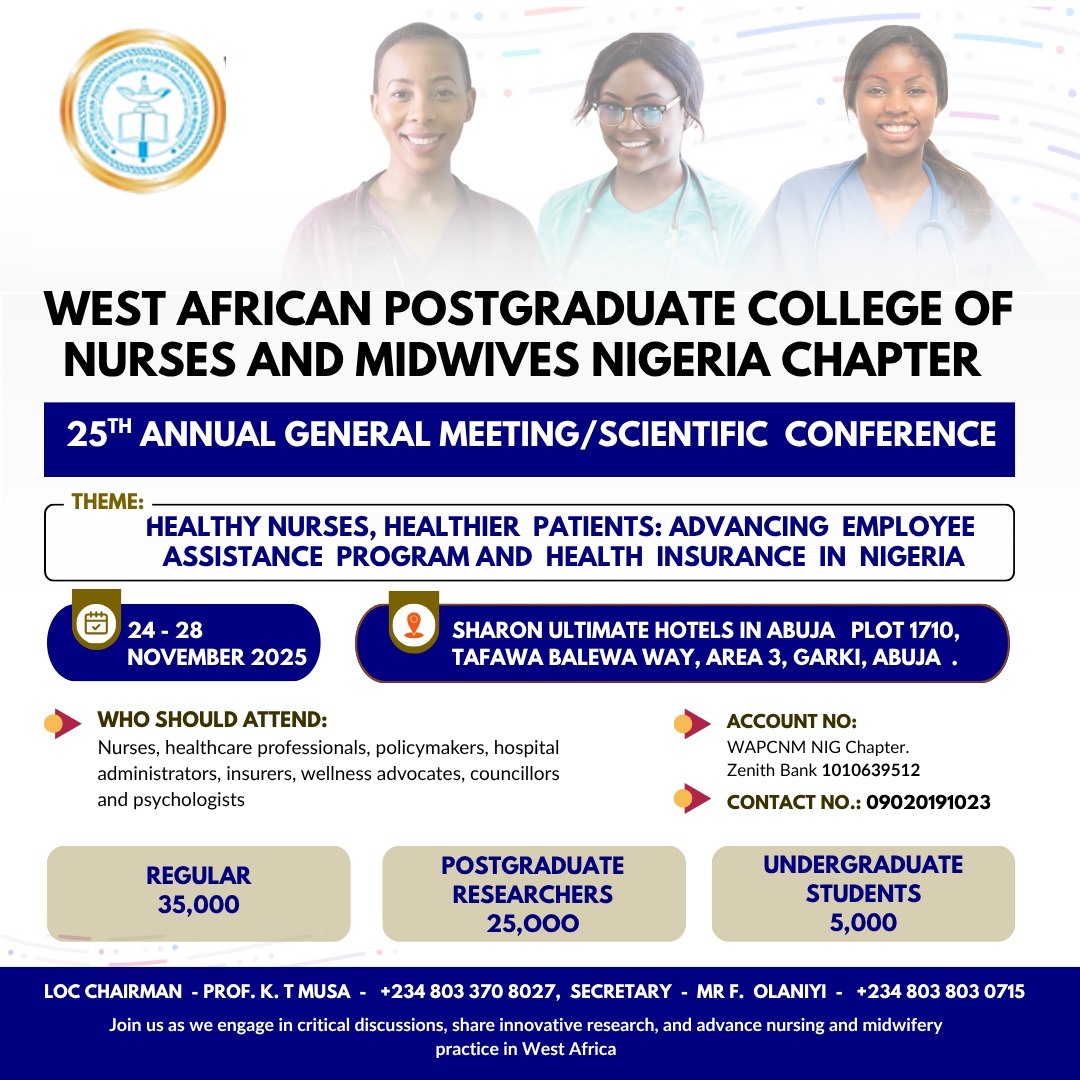
West African Postgraduate College of Nurses and Midwives, Nigeria Chapter, 25th Annual General Meeting/Scientific Conference
West African Postgraduate College of Nurses and Midwives, Nigeria Chapter, …
Akwa Ibom: AHA Basic Life Support (BLS) Schedule
Embark on a transformative learning journey with Medicalworld Nigeria Akwa-…
ABUJA: Basic Life Support BLS, Pediatric Advanced Life Support (PALS), Advanced Cardiovascular Life Support ACLS and First Aid, CPR AED Schedule
Embark on a transformative learning journey with Medicalworld Nigeria Abuja…