Olumide Akintayo has every reason to saunter. He isn’t your garden-variety professional. He is a prouder pharmacist; you can’t be prouder. A rebel of sort, he rejected his parents’ advice to go for Medicine and opted for Pharmacy.
“I don’t like Medicine, but it is a noble profession,” he says with a wry face at The Pharmacy House, Anthony Village, Lagos, where he has his office as the President of Pharmaceutical Society of Nigeria. Of course, he hates seeing blood and life tissues. For 25 decades, Akintayo has been consistently engaged in the administration of pharmacists in Lagos and national level. But his journey to national prominence wasn’t a dog’s breakfast, as he told HENRY AKUBUIRO in this interview, how it all began at Ife as an undergraduate.
How was childhood like?
Basically, early life started in Ibadan, in present-day Oyo State, in the 1960s. By 1976, after the state creation, my parents relocated to present-day Ondo State, comprising Ondo and Ekiti. In terms of primary education, it was at Bodija International School, Ibadan. Then, I proceeded to the famous Christ school, Abeokuta, for my secondary education. Afterwards, I gained admission to study Pharmacy at the pioneer School of Pharmacy in the West African sub region, the University of Ife, now Obafemi Awolowo University, Ife. In pursuit of further studies, I enrolled at the pioneer West African Postgraduate School of Pharmacy, Lagos, sometime in 1992, and graduated in 1997 with a fellowship, which confers you the status of a consultant pharmacist.
Did you have a taste of poverty or were you born with a silver spoon?
I wasn’t born with a silver spoon, but I wasn’t born into poverty either. But, I have to thank faithful God that we didn’t have to pass through all of that [hardship]. I was born into a typical middleclass family. My parents were civil servants. While my father worked in the ministry and later became a broadcaster with NBC, my mum was basically a schoolteacher. It was a modest family. But, thank God, we had parents who were determined to give their children everything they needed, and we attended some of the best schools in our generation. Both Bodija International School and Christ School were among the top schools at that time, and the Great Ife of our generation was, of course, a great school to be proud of.
What was your ambition as a kid? Did you fulfill your dream, or it changed along the way?
With every sense of modesty, one was obviously above average as a student, and the older profession –Law, Medicine –were the attraction those days. But I was a kind of a rebel, because my parents wanted me to be a medical doctor, but I never liked medicine. Of course, it is a noble profession, but I have my problems with it, which I still have up till now –the phobia for blood, life tissue and all that. Luckily, I was very good in chemistry as a secondary school student –that was the beginning of my interest in pharmacy. I saw a couple of community pharmacists in their white, clean overall clothes and in a clean environment, and I felt it was a profession to be in, though some of my friends kept making me fear that pharmacy was a very tough course, especially in Ife, where I wanted to study; but I felt that, if some people could do it, I, too, could do it. To God’s glory, when I sat for JAMB, I put in for Pharmacy, and got it.
At that time, Pharmacy used to have a much higher cut-off mark than Medicine. Even as I speak to you, I understand it is still the situation. You know, Pharmacy has a tradition in Ife. There is no first generation Nigerian university, like UNN, UNILAG, Ife and probably UNIBEN, where the cut-ff mark for Pharmacy was higher than Medicine in this country. In my generation, the year I gained admission, the cut-off mark was 277, and I scored 297; and I was struggling to be part of the top 20 in the faculty that year. I still remember the highest scorer scored 315 that year, with 6 others scoring above the 300 mark. So, the condition for becoming a pharmacist, have always been very tough.
In fact, in our generation, people tended to portray us as anti-social beings, because the daily routine of the Pharmacy student was to wake up, visit the cafeteria and lectures. Everyday in the university, from 6 am to 6 pm, we were permanently in the university attending lectures. Those things have helped a great deal, that’s why, when you see an average pharmacist, he is no ordinary person –he is one who has imbibed polyglotic skills because of the nature of his training. That’s why, if you go to our telecom companies, you will see pharmacists as part of management there as chief marketing officers and chief operating officers. In banking, you see them as general managers and directors.
I am sure you must have heard names like Sam Ohabunwa, one-time President of the Nigerian Economic group –he is a pharmacist; Julius Adelusi Adeloye, probably one of Nigeria’s greatest in the professional light –he is a pharmacist and a lawyer, a doyen of the profession. As a student, Adeloye was privileged to be the only black and secretary of the International Students’ Movement, in which capacity he travelled to over 42 countries. That tells you how versatile pharmacists can be. I can go on and on. All I am saying is that it is the function and depth of training we have as pharmacists.
You stated somewhere that, in your undergraduate days, women used to run away from people like you. How did you manage to get married?
As I told you, the training almost made people anti-social. But, for people like me, with due sense of modesty, I did everything. I didn’t just pass through the university; I made sure the university passed through me. So, I had a very fair share of everything, a balanced life –social and academic, tough as it were. I was involved in departmental and student unionism, being a two-time rep of the pharmaceutical students at the SUG. My social, sporting and political lives were well balanced at Ife.
You married a pharmacist?
No. I think I have taken more than enough of what any pharmacist can take. One of the things I decided from the very beginning was that I wasn’t going to marry a pharmacist.
The National Health bill was passed recently. What does this mean to you and the health sector?
The health bill was passed by the Senate. We must continue to reckon that it has to be made perfect at the House of the Representatives before we can conclude that it is over. But let me start by thanking the Senate President, David Mark, because, at the height of the various undercurrents relating to the bill, I had led a delegation of the National Pharmaceutical Society of Nigeria to the Senate. I also visited the Speaker of House of Reps the same day. So, I am grateful to His Excellency for the approval and for those courtesy calls. I remember one of the things I discussed with Senator Mark was a particular Section 2A at that time, which I told him was unconstitutional after my presentation as the president of the PSN at the public hearing at the Senate.
At that time, the Senate was trying to have a chairman of the Committee for National Tertiary Standard Committee, who will permanently be a medical doctor; and I took a position that that particular provision was a violation of Section 42 1 and B of the 1999 Constitution, because that particular provision in the constitution forbids discrimination against any citizen of Nigeria; it forbids discrimination against a privilege that can be enjoyed by any citizen of the federal republic of Nigeria –and that exactly is what that amounted to, because, at my level now, if I cannot get to peak in any endeavour in the healthcare sector, something fundamental is wrong. Senator David Mark promised to look into that unconstitutionality, and, thank God today, at least that has been dealt with. That was one of the major fundamental discussions and problems we had with the National Assembly.
There is still Section 1. I said that we have various problems with, and the National Assembly needs to do something about it. The major promoter of this section is Senator Ifeanyi Okowa, Chairman of the Senate Committee on Health. Senator Okowa has not been too straight in his postulations, because he continues to give the impression that there are no laws in Nigeria that regulate what we do in the medical profession. As I speak to you today, there is an Act 91 of 1992, which has metamorphosed into Cap 217 Laws of the Federation 2004. Under that law, the Pharmacy Council of Nigeria has the right to regulates pharmacy practice in all ramifications in the country.
So, you cannot say there is no law. There is Medical Laboratory Science Council Act of 2003 that regulates and controls the practice of medical laboratory scientists in Nigeria. There is the Nursery and Midwifery Act that regulates nursing in Nigeria. There is Medical and Dental Council Act that regulates the practice of medical and dental practitioners in Nigeria. So, Section 1.1. of the National Health bill is in conflict if approved by the House of Assembly…
The way it is now?
Yes. You can talk of the National Health System that provides a standard but you cannot regulate, because there are existing laws that regulate all these bodies, and we need to be very careful. That’s one part of it that we have problems with. You know I talked about discriminatory clauses, giving privileges to some people, which is unconstitutional, even when they have changed Section 92B, there is still a Section 92G in the version passed by the Senate, which vests the office of the secretary of that committee I talked about in the Director of Hospital Service. As I said, that position is the birthrights of medical doctors in the Federal Ministry of Health. It is unacceptable to us.
I don’t have any problem with the Director of the Hospital Service –I can be a member –but the secretary of that committee should be appointable. In every clime there is meaningful progress, the private sector has been a cataclysm to the next level. Everywhere in the world, the private sector has a reputation for service delivery. So, we are saying the positions of both the chairman and the secretary should be open to practitioners in both private and public sectors.
For those who don’t understand it, the essence of advocating a Health Act is to have a departure from the past. If the Ministry of Health was doing it right, there would have been no need for the bill. There is another obnoxious section in the bill as passed by the Senate: there is a new Section 10.2 that gives the Minister of Health the power of life and death to give directives, even with the things that are not connected to National Healthcare, and that is a disaster in a democracy, and I am extremely disappointed that the Senate can approve that kind of clause –that one person can do and undo even to the things that are unconnected to the bill. That is the problem we need to still resolve. There is also Section 13 that is an aberration.
These are salient and fundamental issues you need to address before we can even talk of the National Health Act. Therefore, the Pharmaceutical Society of Nigeria has taken a position that the House of Reps should not take the usual method of concurring; this is a very defective bill; we need to sort things out before passing it. We are not fundamentally opposed to the concept and need of a National Health bill; all we are saying is that, if we have had fundamental issues with other health laws, don’t let us continue with that unfortunate tradition, because the days have gone where some people in their idiotic mindset continue to imagine there is an hierarchical order in the health sector of a junior and senior partner. I am a freeborn of the Federal Republic of Nigeria, and I cannot accept a subordinate status to anybody. God forbid!
Many Nigerians think we are losing the health war against fake drug, who is to blame?
The truth is that government has not demonstrated enough political will to solve the problem of fake drugs.
Even with the existence of NAFDAC?
It is not about NAFDAC; it is not entirely about NAFDAC or the Pharmaceutical Society of Nigeria. These are the two major agencies that have the latitude. The law is okay, but it goes beyond the law. As at 2012, we had less than 4,000 registered pharmacies in Nigeria: manufacturers, distributors and less than 10, 000 registered patent medicine dealers, but the number of drug sellers, as far back as year 2000, in the 20 local government areas of Lagos, after we carried a survey, was confirmed to be about 112,000. So, realistically, today, we have over 1 million unregistered drug sellers. If you consider that kind of magnitude, you have to really position yourself to cover the lost ground.
What has made Nigeria an attractive dumping ground for fake drugs is the ease with which these drugs can be distributed. If you bring in 1 million worth of consignments this night through the seaport and airport in Lagos, I can tell you that, within 24 hours, they will be all over the nooks and crannies of Nigeria through the network of over existing 40 drug syndicates scattered over the major cities of the country. All you need to do is to stop these cartel and the vehicles used in moving these drugs, and you restore normalcy.
It is not talking about one agency or two –government needs to come up with reasonable force to solve this problem. Government has come up through the Federal Ministry of Health today with a new National Drug Resolution guideline. The deadline for the implementation should actually be January. It sounds utopia to see how that deadline will see the light of the day. Government needs to do more than it is doing if it wants make headway. The regulatory agencies need more support of government before they can achieve their core goals.
There is fear that with the rise herbal mixtures in Nigerian, professional pharmacists like you will be run out of business soon. How safe are these herbal remedies, and do you think you will still be relevant 10 years from now?
If you understand pharmaceutical science is all about, you will know that all drugs emanate from a natural origin. The reason why you don’t place maximum premium on the natural extracts is because they are not economically viable and so unsustainable, that’s why you must always bring them to the laboratory to synthesis new molecules from them. So, if you ask me, they are not a threat at all, especially from those who are doing the right thing. I am sure you must have heard of the popular Fagara extract used in tackling cycle cell anemia. It is strong and a product of research.
The problem we really have is the abundance of impostors, who claim to be herbal practitioners, but, in reality, they are quacks. These people don’t even know the clinical efficacy of the drugs being peddled; they are just mixing nonsense. Most times, when you take them to quality control labs, you discover that they have added orthodox drugs into those things they parade. Very few of them are genuine. Mind you, pharmacists are experimental scientists. As I am speaking to you, there are more than 1,000 drug molecules that have not been commercially exploited in this country. So, herbal practitioners cannot pose any threat to us.
If you were not a pharmacist, what would you have been?
When I gained admission –normally there were two choices – both the first and second choices were Pharmacy. If I had an opportunity to do it all over again, I would still enter Pharmacy. Let me use this opportunity to thank the members of the Pharmaceutical Society of Nigeria, who have demonstrated an unusual immensity of liberality in encouraging me to organize Nigerian pharmacists from level to level in the last 25 years, from a state official –some who started as social secretary before crisscrossing to the Lagos State executive for about 18 years, including the chairman and the secretary –to the apex level to the president of Pharmaceutical Society of Nigeria. It is not all the time that people are this benevolent. That’s why I owe them everything in terms of good performance, to elevate the profession, to move from obscurity to popularity and from declivity to popularity. I guess we are on track to do just that.
ABUJA: Training Schedule for Basic Life Support BLS, Pediatric Advanced Life Support (PALS), Advanced Cardiovascular Life Support ACLS, First Aid, CPR, AED
PORTHARCOURT: Training Schedule for Basic Life Support BLS, Pediatric Advanced Life Support (PALS), Advanced Cardiovascular Life Support ACLS, First Aid, CPR, AED
LAGOS: Training Schedule for Basic Life Support BLS, Pediatric Advanced Life Support (PALS), Advanced Cardiovascular Life Support ACLS, First Aid, CPR, AED
STOP paying for airtime and electricity, Let your phone pay its bills with ScreenT
You may also like

FG Supports Robotic Surgery Expansion to Reduce Medical Tourism
Nigeria is taking another step toward strengthening specialised healthcare …
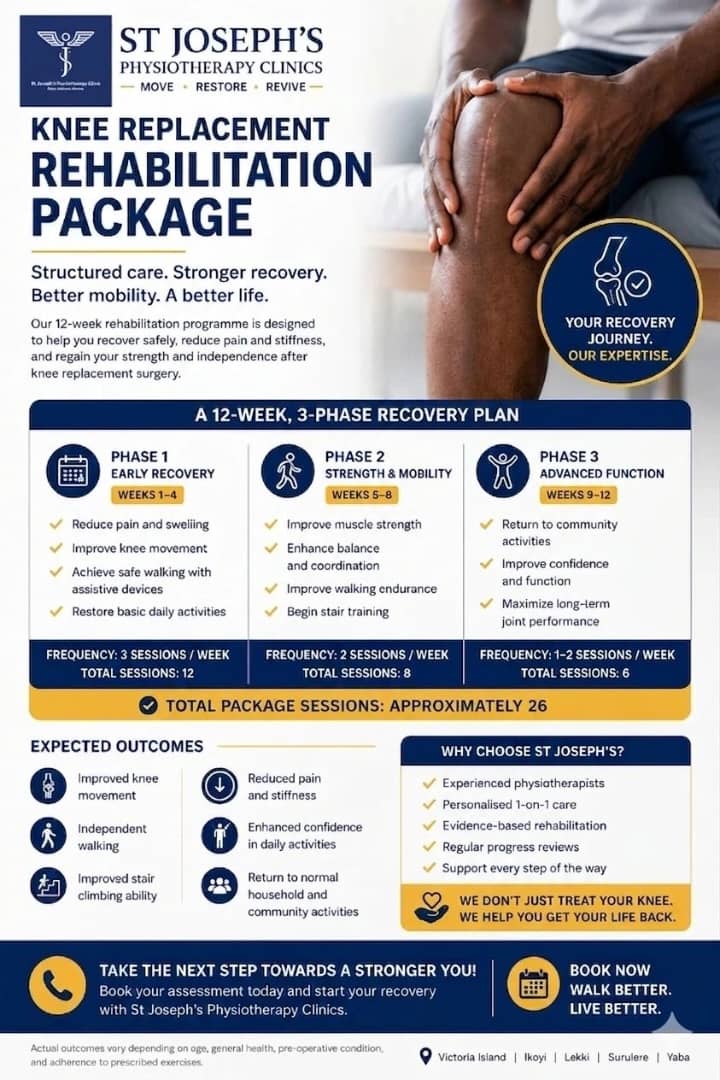
Complete Knee Replacement Rehabilitation Package in Lagos
Knee replacement surgery is a major step toward pain relief and improved mo…

NAMDA threatens strike over unpaid medical lecturers’ allowances
The Nigerian Association of Medical and Dental Academics (NAMDA) has warned…

Resident Doctors Signal End to Strike Threat After High-Level Talks with Gbajabiamila
The threat of a nationwide indefinite strike by the Nigerian Association of…
AMLSN Issues Strong Rejoinder to NAMDA on Public Service Establishment Matters
The Association of Medical Laboratory Scientists of Nigeria (AMLSN) has rel…