ROAD MAP TOWARDS UNIVERSAL HEALTH COVERAGE AND OTHER PRESSING ISSUES IN THE NIGERIAN HEALTH SECTOR
ROAD MAP TOWARDS UNIVERSAL HEALTH COVERAGE AND OTHER PRESSING ISSUES IN THE NIGERIAN HEALTH SECTOR
Being text of the address Delivered By: Dr. Lawrence Kayode OBEMBE
B.Sc. Med. Sc., MBBS, FMCOG, FWACS, FIAMN, FAGP, FICS, DMP
Hon. DG., M.O.W., J.P, KJW
President. Nigerian Medical Association
DURING THE WORLD PRESS CONFERENCE held at NMA NATIONAL SECRETARIAT, ABUJA ON Tuesday 12 May, 2014
The 1999 constitution of the Federal Republic of Nigeria as amended chapter II, fundamental objectives and directive principles of state Policy Article 17 (3) (d) says the state must ensure that there are adequate medical and health facilities for ALL personsÂÂ
In as much as the constitution is supreme according to the rule of Law, health, for every Nigeria citizen is a right, and not a privilege.
Universal health coverage UHC was placed on the global agenda when the 58th World Health Assembly in 2005 adopted a resolution calling on member states to `develop their health systems, so that all people have access to health services and do not suffer financial hardship paying for them` WHO 2005. Evidence abounds all over the world that the impact of UHC schemes at increasing access, financial risk protection and improving health systems of population rests on Community Health Insurance (CHI)
The first Bill on Health Insurance was first presented to the Parliament in 1962 by the Honourable Minister of Health Sir Dr. Majekodunmi, an Obstetrician and Gynaecologist of International repute. It took roughly 40 years after, for the bill to see the light of day, and since the flag off of the formal sector on 6th June 2005, the coverage has remained roughly 5%. What is most disappointing in the scheme is the fact that 98% of the coverage has been only for Federal Civil Servants, the states and local Governments have not come on board, and in some instances even constitute impenetrable barrier towards reaching the community. Most appalling again is the fact that 80% of disease burden can be managed in properly organised community health insurance programmes, 15% at secondary level and only 5% should actually navigate to tertiary level, but the reverse is the case, teaching hospitals are inundated with catarrh, malaria, diarrhea etc. Artificial barriers and imaginary concepts are always devised to forestall necessary access to adequate healthcare at community level and so our health indices remain dastardly macabre.
It is the responsibility of the Nigerian Medical Association to chart the way forward in Nigerian Health sector and that is why in my capacity as the President, NMA, I am calling on the media to come to the aid of every Nigerian in stepping to the `Road Map towards Achieving Universal Health CoverageÂÂ and make all government agencies realize that HEALTH IS A RIGHT AND NOT A PRIVILEGE`. The following steps must be followed to take Nigeria to the promised land of UHC.
STEP 1: For every Nigerian citizen, a certain amount must be deposited at the community level as premium to guarantee minimal level of healthcare. This is the Community Health Insurance Fund (CHIF). This should not affect negatively any of the current health programmes in existence in that community. The emphasis here is `community ownership`. It is a horrendous lacuna in our health system that need to be filled.
STEP 2: If this amount is `X`, the equation for CHIF is as follows:
CHIF = X/live/Govt/month
What is the value of X?
Health Insurances operates on monthly calendar.
STEP 3: The value of `X` is the amount an enrollee at the community level decides on his/her own volition to contribute, without any stress on household pocket expenditures.
In AYEDUN community in Ekiti state, the enrollees decided to pay one hundred naira per month. The Local/State/Federal Governments are expected to subsidize with N100 each, that is N400 per live per month. This is comparable to what operates in Rwanda, Thailand and India.
STEP 4: The benefit package roughly equates to MDG 4, 5, 6, plus Road traffic
Accident. See table belowÂÂ
Table 1:
UNIVERSAL HEALTH COVERAGE (UHC) 2015
COMMUNITY HEALTH INSURANCE FUND (CHIF)
PAYOR PREMIUM PACKAGE
FEDERAL GOVERNMENT N100 CHILD HEALTH (MDG4)
STATE GOVERNMENT N100 MATERNAL HEALTH (MDG5)
LOCAL GOVERNMENT N100 MALARIA/INFECTIONS (MDG6)
HOUSEHOLD ENROLLEE N100 ROAD TRAFFIC ACCIDENT
TOTAL N400 PER ENROLLE PER MONTH ($1 TO N157)
CO-PAYMENT = N100
STEP 5: The sum total can be funded with 2% consolidated revenue fund payable directly into CHIF at community level. The constitution guarantees that such decision can be approved by the National Economic Council without tendentious or tenuous bureaucracy.
STEP 6: Three structures need to be put in place at the community level:
(1) WARD HEALTH ORGANIZATION (who)
(2) HEALTH MAINTENANCE ORGANIZATION (HMO)
(3) HEALTH CARE PROVIDER (HCP)
This is the tripod stand that holds the CHIF scheme.
STEP 7: The WHO has the traditional rulers as the PATRON, and the Council (Board of Trustees), the Association (household leaders) fall under according to the organization`s organogram. The BOT are elected by Ward Health Assembly, and they meet once a month immediately after the cleaning exercise on Environmental Sanitation Days.
STEP 8: The Health Maintenance Organization is the accounting officer and takes responsibility by ensuring that the fund is judiciously spent on health according to NHIS directives i.e capitation 60%, fee for service 20%, Administration 20%, 1% return to NHIS, 4% BOT/, 15% Administration HMO.
All states that have not embarked on MDG should appoint their HMO with advice from NHIS, using sharing formula, not scrambling, not contractual bidding.
With this scheme, ALL Nigerians will be captured on the community basic plan (170 million).
STEP 9: Health Care Providers are health facilities in the community which should be managed by an MBBS doctor. Capitation is paid into that facility.
Other supporting staffs may be co-opted as the need arises. The HCP facilities could be designated also as registration centres depending on the convenience of the enrollees.
STEP 10: In order to bring scientific research into health insurance industry, an Institute of health technology and actuarial sciences should be established in communities with enrollees up to 3000 and landed area of 5 hecters and to be incorporated with the college of health sciences of the newly established Federal University of that zone.
With steps 1 to 10 Nigeria will reach the promised land of Universal Health Coverage (UHC) in no distant future. - Ref: www.premiermedicaid.com.ng
OTHER ISSUES:
The following issues are very topical in the health sector and need urgent attention.
(1) Abducted Girls in Chibok
(2) Surgeon General/Minister of Health
(3) CBN circular on INVITRO-DIAGNOSIS
(4) Diaspora Doctors/Medical Tourism
(5) JOHESU strike
(6) Medical Rescue Squad (MRS)
(7) National Health Bill
(8) Residency Training programme overseas attachment
(9) Placement of fresh medical graduates for House-manship
(10) Security for Doctors Police protection - Sacrosanct
(11) RELATIVITY IN HEALTH SECTOR
(12) Retirement Age (70)
(13) Skipping
In order to guarantee peace, progress and harmony in the health sectors, the Government should tackle these naughty problems headlong without unnecessary procrastination or prevarication.
By:
Dr. Lawrence Kayode OBEMBE
President, Nigerian Medical Association
ABUJA: Training Schedule for Basic Life Support BLS, Pediatric Advanced Life Support (PALS), Advanced Cardiovascular Life Support ACLS, First Aid, CPR, AED
PORTHARCOURT: Training Schedule for Basic Life Support BLS, Pediatric Advanced Life Support (PALS), Advanced Cardiovascular Life Support ACLS, First Aid, CPR, AED
LAGOS: Training Schedule for Basic Life Support BLS, Pediatric Advanced Life Support (PALS), Advanced Cardiovascular Life Support ACLS, First Aid, CPR, AED
STOP paying for airtime and electricity, Let your phone pay its bills with ScreenT
You may also like

FG Supports Robotic Surgery Expansion to Reduce Medical Tourism
Nigeria is taking another step toward strengthening specialised healthcare …
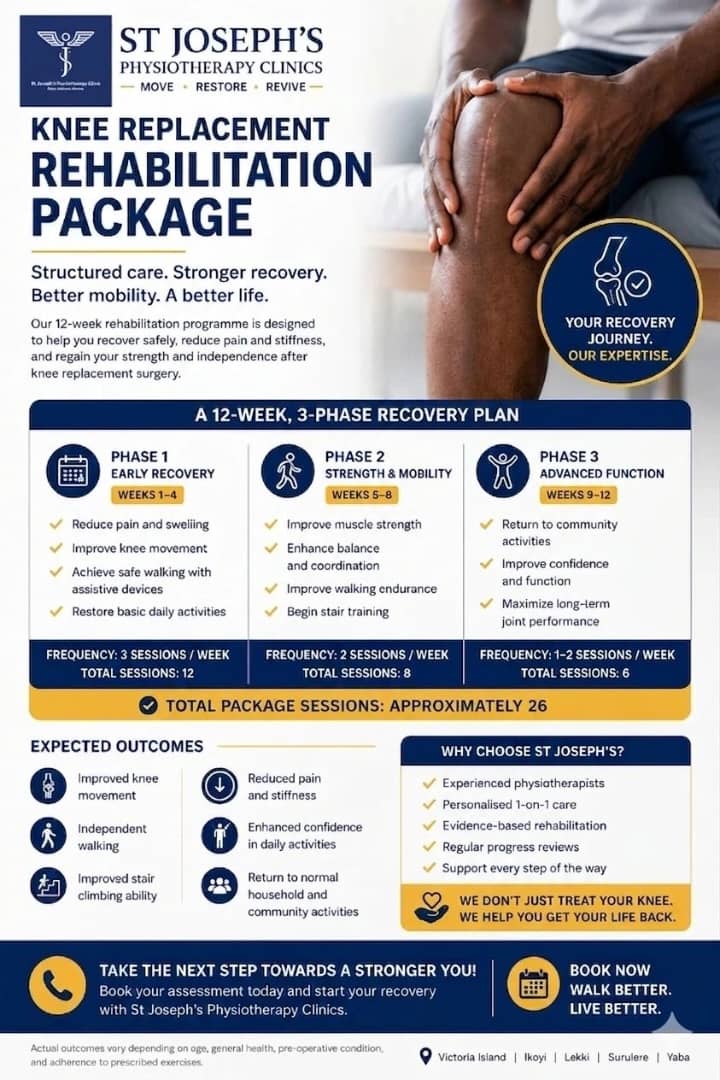
Complete Knee Replacement Rehabilitation Package in Lagos
Knee replacement surgery is a major step toward pain relief and improved mo…

NAMDA threatens strike over unpaid medical lecturers’ allowances
The Nigerian Association of Medical and Dental Academics (NAMDA) has warned…

Resident Doctors Signal End to Strike Threat After High-Level Talks with Gbajabiamila
The threat of a nationwide indefinite strike by the Nigerian Association of…
AMLSN Issues Strong Rejoinder to NAMDA on Public Service Establishment Matters
The Association of Medical Laboratory Scientists of Nigeria (AMLSN) has rel…