Communique issued at the end of the 32nd scientific conference and annual general meeting of the association of public health physicians of Nigeria held at the NAF conference centre and suites, abuja from 14th-18th march, 2016
Preamble
The Association of Public Health Physicians of Nigeria (APHPN) had its 32"" Scientific Conference and Annual General Meeting at the NAF Conference Centre and Suites. Abuja from 140'-1 8th March, 2016. The theme of the conference was "Universal Health Coverage: The Way forward in attaining Sustainable Development Goals (SDGs) in Nigeria". The thematic areas covered during the scientific presentations included Polio Eradication in Nigeria, Emerging and Re-emerging and Neglected Tropical Diseases, Operationalization of the National Health Act, the Role of Quality Maternal Health in achieving Geuder Equality and Public health challenges of Internally Displayed People (IDPs).
The Honourable Minister of Health. Prof. I.F. Adewole FAS, DSc (Hons), represented by the Ag Director of Public Health, Federal Ministry of Health, Dr E. Ngige, attended the opening ceremony and declared the conference open. This year's Isaac Ladipo Oluwole lecture titled "Universal Health Coverage: Key to the Attainment of Sustainable Development Goals" was delivered by Dr C. L. Ejembi, a Consultant Public Health Physician with the Ahmadu Bello University Teaching Hospital, Zaria.
 During the plenary and strategic sessions on the year's theme, sub-themes and Annual General Meeting, the following observations were made:
 Observations
I. That Nigeria made significant progress in the attainment of the Millennium Development Goals (MDGs) especially with the reduction in Child mortality rate and Maternal mortality ratio by 45% and 52% respectively.
2. However, the weak health system, vertical implementation of programmes and very low budgetary allocation to health with poor allocative and technical efficiency were some of the militating factors against attainment of the targets.
3. Universal Health Coverage in Nigeria has been driven through Primary Health Care. However, the Local Government Authorities lack capacity and political will to deliver on this mandate
4. That if machinery is not put in motion at this early phase of SDG implementation to prevent the militating factors that prevented the attainment of the MDGs , the attainment of the SDGs will be impossible
5. Health equity and sustainable development as recommended by the Rio Declaration which are key to achieving Universal Health Coverage, cannot be attained in the face of the weak health system in Nigeria.
6. Equity in access to service, quality of health service and financial risk protection are the major ingredients towards the attainment of the Universal Health Coverage.
7. The National Health Insurance Scheme, a veritable tool to Universal Health Coverage, has been bedeviled by poor fund generation and narrow fiscal space militating against scaling up of the scheme.
8. Out of Pocket Expenditure (DOPE) contributes about 62% of health expenditure in Nigeria. This results in catastrophic health expenditure among already impoverished population.
9. The absence of proper private sector engagement in developing sustainable health care financing system and the need for government incorporation of the private sector in this
10. The expertise and skills of public health physicians in the country have not been fully harnessed to strengthen PRC at local government level
11. It is commendable, the concerted efforts put up by Nigeria in the spirited fight against the outbreak of Ebola and the consequent recognition conferred on the Nigeria Centre for Disease Control (NCDC) for the well co-ordinated response. However, the poor surveillance network still remains a recurring gap in our Epidemic Preparedness and Response in Nigeria
12. The Epidemic Preparedness and Response in Nigeria is majorly driven and over reliant o~ Federal system making preparedness and response slow and inadequate.
13. That the National Health Acthas been signed into law in October, 2014 and Gazetted in January 2016 marking an important step in its implementation. It is also observed that structures fOJ implementation have been set up, guidelines are being worked upon, but 'Presidential launch oj the NHA is still being awaited.
14. There is no documented database of Internally Displaced Persons (lOPs) and there is nc comprehensive public health approach to solving their health challenges.
15. We commend the concerted efforts of all stakeholders in ensuring Nigeria's removal from the list of Polio endemic countries. There is however the tendency to relax the robust strategies put it place to achieve this status.
Recommendations
1. The Out OfPoeket Expenditure (DOPE) which contributes about 62% of health expenditure it Nigeria should be leverage on by the Government to finance healthcare through mandatory heald insurance.
2. 'While we recognize political will for implementation as impediment, nonetheless, there is the need for Government to pool fund from SOurces like Aviation, Telecommunication sectors etc to finance health care in Nigeria. This pooled fund should be used to offset the contributions of tbe poor.
3. NHIS should be reorganized and empowered to accelerate the attainment of Universal Health Coverage through effective community based health insurance.
4. The NHA should be speedily launched to avail Nigerians of the benefits in implementing the Act.
5. The APHPN is committed to partnering with relevant Government agencies to ensure that the implementation of SDGs is streamlined.
6. The APHPN is ready to suppcrt the government to strengthen PHC at the LGAs so as to actualise Universal Health Coverage using global best practices
7. There is need for Government at all levels to put in place robust surveillance network anc epidemic preparedness and response at state and regional level to fast track response operations a' and when dues.
8. APHPN will continue to engage NCDC on collaborative capacity building and strengthening of health system.
9. Government should identify and document public health challenges of IDPs in Nigeria. APHPN is willing to team up with relevant agencies to develop comprehensive database and address their health and social needs.
Prof. T.M. Akande
National Chairman
Dr. S.A. Aderibigbe
Secretary General
ABUJA: Training Schedule for Basic Life Support BLS, Pediatric Advanced Life Support (PALS), Advanced Cardiovascular Life Support ACLS, First Aid, CPR, AED
PORTHARCOURT: Training Schedule for Basic Life Support BLS, Pediatric Advanced Life Support (PALS), Advanced Cardiovascular Life Support ACLS, First Aid, CPR, AED
LAGOS: Training Schedule for Basic Life Support BLS, Pediatric Advanced Life Support (PALS), Advanced Cardiovascular Life Support ACLS, First Aid, CPR, AED
STOP paying for airtime and electricity, Let your phone pay its bills with ScreenT
You may also like

2027 NNPC/Renaissance JV Sabbatical and Postgraduate Research Internship Programme
2027 NNPC/Renaissance JV Sabbatical and Postgraduate Research Internship Pr…
2026 RIVERS STATE EMERGENCY BASIC & ADVANCED LIFE-SUPPORT TRAINING
WHEN THE NEXT EMERGENCY CALLS, WILL YOU BE READY?Port Harcourt | Medicalwo…
2026 LAGOS EMERGENCY BASIC & ADVANCED LIFE-SUPPORT TRAINING PROGRAMME
WHEN EVERY SECOND COUNTS, BE READY. In emergency care, there is no room fo…
2026 EMERGENCY BASIC & ADVANCED LIFE-SUPPORT TRAINING — ABUJA
WHEN EVERY SECOND COUNTS, ARE YOU READY?In emergency care, clinical decisio…
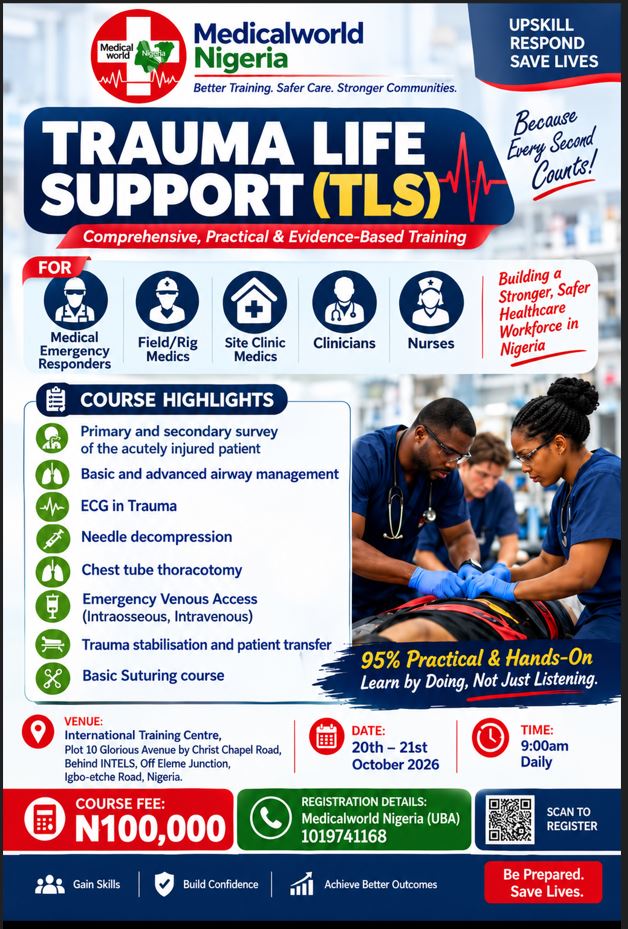
Trauma Life Support (TLS) For Medical Emergency Responders, Field/Rig Medics, Site Clinic Medics, Clinicians, Nurses
Trauma Life Support (TLS) For Medical Emergency Responders, Field and Rig …
